
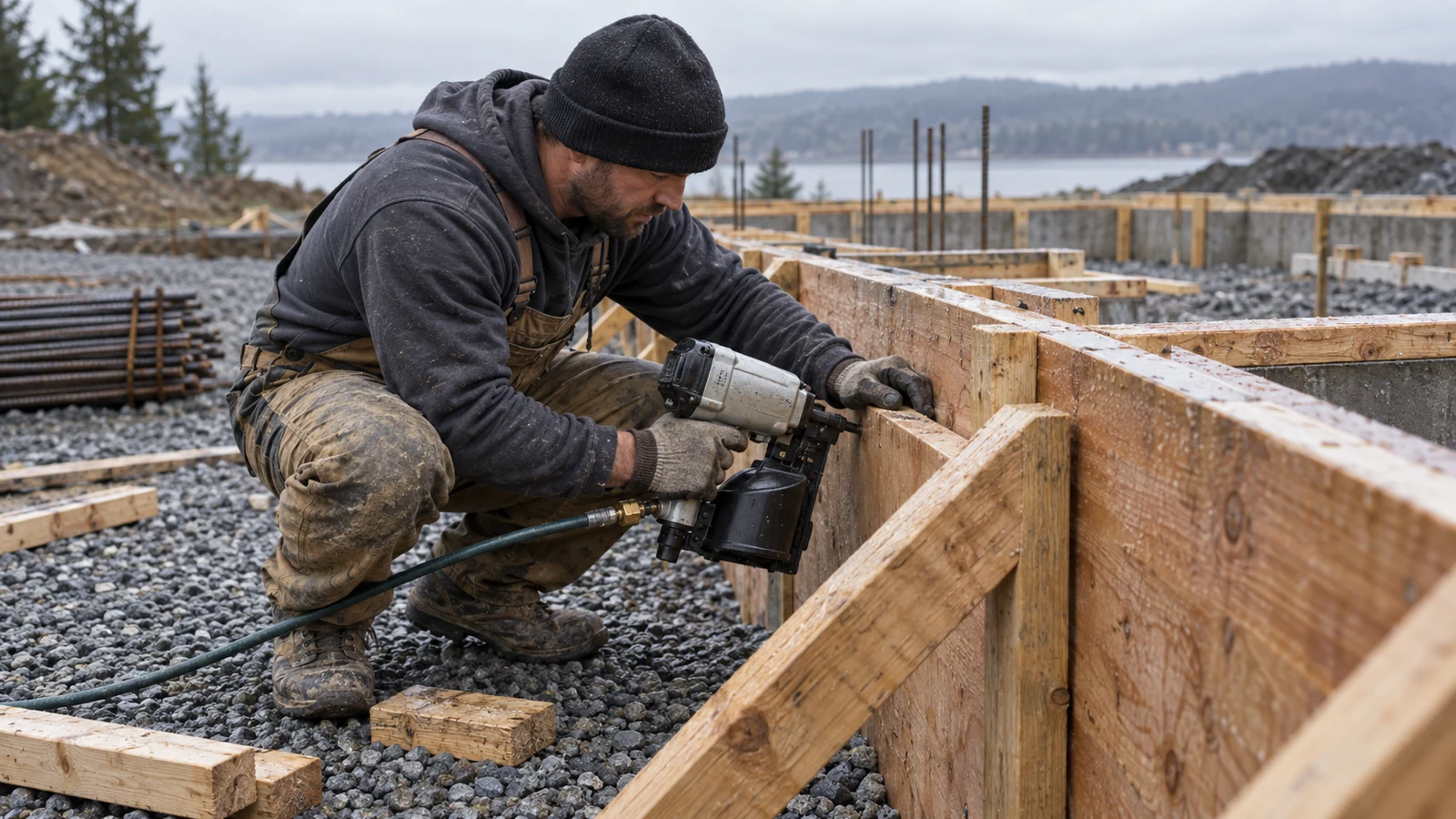
Coil nails for concrete formwork should be chosen for the stripping sequence, not only for the assembly shift. A form is a temporary structure that is built, loaded, and then taken apart. The fastener has to hold the sheathing and framing during the pour while still allowing the crew to remove the boards without destroying the surface for the next use.
ProAirNails recommends a strip plan that names the contact pressure, sheathing, stud and waler layout, tool access, stripping method, board reuse target, and inspection points. The plan turns a general nail request into a decision the formwork crew and the buyer can both check.
Design the form for the day it comes down
Start with the form drawing and the concrete pressure assumption. Identify where the sheathing spans between studs, where the studs meet the walers, and where the stripping crew will need a lever or wedge. The nail pattern should follow the structural layout, not an even grid applied across the whole face.
The ACI formwork topic reference explains that formwork design, safety, and removal are engineering decisions. Confirm that the form design and stripping conditions are approved by the responsible engineer before the fastener plan is released.
Map coil nails for concrete formwork by contact path
| Location | Fastener role | Strip question |
|---|---|---|
| Sheathing to stud | Keep the face aligned under pressure | Can the board be lifted without tearing the face? |
| Stud to waler | Transfer load between framing members | Does the joint stay tight during the pour? |
| Panel edge | Close the seam and control grout loss | Can the edge be stripped without breakout? |
| Blocking and ties | Hold local hardware and reveal formers | Is the nail clear of the tie and stripping path? |
Mark the hidden and exposed sides of the form on the same drawing. The nail that is easy to drive may sit directly in the path of a wedge, a tie, or the next board's reuse zone.
Reuse starts with the first strip
Photograph a representative panel before the pour, after the pour, and after stripping. Record where the plywood face tore, where the nail heads sat, and where the crew needed extra force. Those three photographs tell the buyer more than a single pull test because they show the actual contact and removal path.
Form oil, release agent, and coating choices belong to the form design and the concrete finish schedule. Keep them separate from the nail decision, but include them in the strip review because they change how easily the board releases.
Count the strip cycles before ordering
- Confirm the sheathing type, thickness, and expected reuse count.
- Record the stud and waler spacing used on the form.
- Check the nailer pressure and the driver setting on the real board.
- Test the stripping tool and the access position the crew actually uses.
- Retain a stripped panel, a carton label, and a photograph of the damaged zone.
For coil nails for concrete formwork, a first-use sample is only the beginning. The useful evidence shows what the board looks like after the pour and whether the next assembly still holds the intended line.
Keep form oil and coating decisions separate
Do not infer fastener performance from the colour of a coating. Ask for the declared material, finish, and intended exposure, then compare that declaration with the form design and the site conditions. A coated nail is not a substitute for the correct form oil or the correct stripping procedure.
If the form will be used near salt water, in a wet environment, or with a chemical release agent, record that condition before ordering. The exposure belongs in the RFQ even when the form is temporary.
Inspect feed, heads, and board damage
| Observation | Check first | Do not assume |
|---|---|---|
| Feed interruption | Coil geometry, collation, magazine, and pressure | A larger nail will fix the feed |
| Proud head | Driver depth, nose, board hardness, and support | More pressure is always the answer |
| Torn face on stripping | Nail head, board face, release agent, and wedge position | The board is simply worn out |
| Loose framing joint | Nail length, penetration, spacing, and stud condition | A longer nail will always hold better |
The ASTM F1667 driven-fastener reference gives common terms for nail dimensions, materials, and finishes. It does not approve a formwork joint or a stripping method, so the form drawing and the site procedure remain in control.
Plan the release around the pour
The OSHA formwork requirements address design, inspection, and removal conditions. Confirm who inspects the form before the pour and who authorizes removal afterward. The nail plan must not create an obstacle to that inspection or to the safe stripping sequence.
ProAirNails can help buyers compare coil nails, review related pneumatic nails and screws, and submit a formwork brief through Contact Us. Include the form drawing, sheathing, framing, pressure assumption, tool, candidate coil, stripping method, reuse target, quantity, and schedule.
Send a formwork RFQ with the strip plan
At reorder, compare shank, point, head, finish, collation, coil diameter, count, label, and lot identity. The approval for coil nails for concrete formwork should name the form design, board type, and stripping method it covers.
A bench pull test cannot prove a form will strip cleanly after a pour. Concrete pressure, board moisture, release agent, and the crew's stripping method all change the outcome, so the release file should include the pour and strip photographs rather than a single laboratory number. ProAirNails treats that limitation as part of the approval.
FAQ
Why are coil nails for concrete formwork different from permanent framing nails?
The form is designed to be removed, so the nail must hold during the pour while allowing the board to strip cleanly.
Who approves the formwork design?
The responsible engineer or the authority named in the project documents controls the form design and removal conditions.
How many reuse cycles can a form board take?
That depends on the board, oil, stripping method, and pour conditions. Test the actual form rather than assuming a fixed number.
Should the nail pattern be uniform?
No. Follow the stud, waler, tie, and reveal layout on the form drawing.
Why photograph the stripped panel?
The stripped face shows where the head, wedge, and board interacted during removal.
Does a coating choose the nail for me?
No. Confirm the declared material, finish, exposure, and form design together.
What should a formwork sample include?
Include the board, nail, tool setting, carton label, pour photograph, and stripped-panel photograph.
What changes trigger a new formwork review?
Review changes to the form design, board, framing, pressure, oil, nail, tool, stripping method, or pour sequence.
What should the formwork RFQ contain?
Send the drawing, materials, pressure assumption, tool, candidate coil, stripping plan, reuse target, quantity, and schedule.
What is the final strip question?
Ask whether the form held the intended line during the pour and whether the board can be reused after removal.