
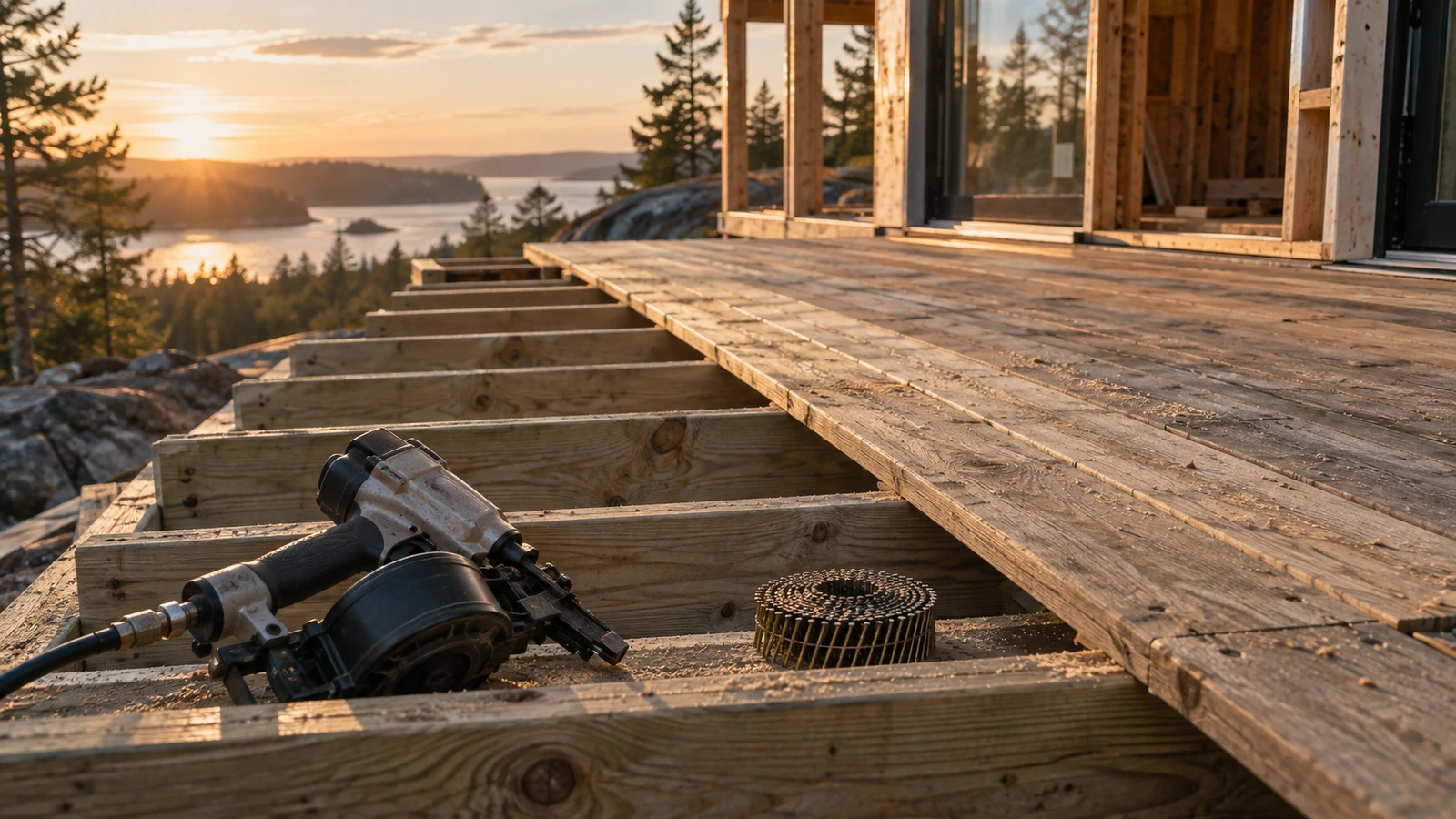
Lay a deck in February and look at it again in August. The boards have grown. A 140 mm board can pick up three or four millimetres of width across a wet spring, and every one of those millimetres arrives at the fixing and the gap you set at the joist.
Most of the enquiries ProAirNails takes about coil nails for decking arrive as a gauge question, and the gauge does matter. What decides whether the deck is still quiet in year ten is something else: which way the board is allowed to move, and which way the fixing lets it.
What a deck board does between February and August
Decking is exterior timber, so it lives at whatever moisture content the weather hands it rather than at the 10-12% a workshop keeps. Wet spring air takes a board up towards 20%, and at that point a 140 mm softwood board is measurably wider than it was when it was nailed down.
That movement happens across the width. Along the length a board hardly changes at all, which is why deck problems almost always show up as closed gaps, cupped edges and ridges rather than as stretched boards. One sentence, and it settles most of the fixing detail on the whole deck.
Three loads, and only one of them is pull-out
Withdrawal gets all the attention because it is the easy one to test. On a real deck the coil nails for decking are asked to do three different jobs, and a nail chosen only for the first one will be wrong somewhere else.
| Load | When it appears | What actually resists it |
|---|---|---|
| Withdrawal | A board cups and lifts its edge as it dries | Shank deformation, then head bearing on the board face |
| Lateral shear | The board slides across the joist as it swells | The gap between boards, and a shank that can slip in its hole |
| Rotation | One edge of a board lifts under a foot | Head diameter, seating depth and how much joist sits under the fixing |
Decking also takes a fourth, slower load: corrosion. That one is a material question rather than a shape question, and it is covered further down.
Where ring shank coil nails for decking earn their money
A ring shank nail is deformed along the shank so the timber fibres close around the rings and hold. Withdrawal values climb steeply compared with a plain shank of the same diameter, and the difference is felt on the boards that lift first.
Two places on a deck justify the extra cost immediately. The first is a board end, where there is only half a joist of timber behind the fixing and a short edge that dries faster than the middle. The second is any deck being re-boarded onto joists that already have a hundred old holes in them, because a ring shank will hold in a hole that a plain shank drops straight through.
Plain shank still has a place, just not the whole deck
Plain shank coil nails drive faster and set deeper with less air pressure, which is why they dominate volume residential work. They rely on head bearing and on a gap that absorbs the board's width change instead of the shank doing it.
That is a legitimate design. It stops being legitimate the moment the gap is closed up tight to save timber, because then the movement goes looking for the weakest thing in the assembly and finds the fixing.
Coating and corrosion decide the service life
Electroplated nails are for interiors and dry weather, and most failed coil nails for decking were chosen on that line and then used outdoors. Hot dip galvanized or a mechanical galvanized coating belongs wherever rain sits on the deck, and stainless steel belongs within sight of salt water or in contact with modern copper-based treated timber.
The coating has to survive the whole life of the deck, not the first season. Galvanized then rusted is not a compromise; it is a fixing that has quietly become a smaller one.
Spacing, gap and where the joints land
Coil nails for decking can only accommodate the movement that the gap gives them, so this is the first figure to agree on site rather than at the quotation stage. Gaps of 3 to 6 mm are normal for exterior decking, wider for a species that moves a lot or for boards laid wet. Two fixings per board at every joist is the working rule, set in from the board edge by enough to avoid splitting the arris.
End joints need a double joist or a purpose-made end bracket underneath, and the fixings either side of the joint should be set back from the end of each board. A board end fixed hard into a single joist will split along the grain within two seasons.
What actually goes wrong on site
| What you see | What caused it | What to check |
|---|---|---|
| Boards loose after one season | Shanks that could not hold once the board dried | Shank type against board end and old joist condition |
| Split along a board edge | Fixing too close to the arris, or two fixings fighting | Edge distance and whether a gap was left at all |
| Ridges and closed gaps in spring | No allowance for width change | The gap set on the day and the species used |
| Rust staining running down the boards | Coating gone before the deck was | Coating grade against the timber treatment and location |
Checks before the first coil goes in
- Measure the moisture content of a few boards, not just the top one on the pack, and write the number down.
- Confirm the species, because a dense hardwood decks beautifully and moves far more than the softwood it replaced.
- Set the air pressure with the coil and the tool you will actually run, and check the head sits flush rather than sunk.
- Agree the gap with whoever will live with the deck, since the client sees the gap daily and the engineer rarely does.
- Record the coating grade against the timber treatment and the distance to the coast.
What the fixing cannot do
No coil nail will hold a board that was laid wet and has since dried, and none will stop a joist that was already soft from moving underfoot. A deformed shank does not rescue joists at 600 mm centres carrying a 25 mm board, and it does not compensate for a deck built without a gap.
This article is about how a deck board is fixed down. Where a deck is structural, holds a balustrade or forms part of a fire-rated assembly, the connection detail comes from the designer, and ProAirNails works to that detail rather than around it. The ASTM F1667 specification for driven fasteners is the reference for what a nail is allowed to claim about itself. For the movement side of the question, the USDA Wood Handbook sets out how moisture changes the dimensions of timber far more clearly than any supplier note.
FAQ
Which gauge should a deck use?
A thicker shank holds better and splits thinner boards sooner. The workable gauge for coil nails for decking depends on species, board thickness and how close the fixings sit to the edge, so it belongs in a trial rather than in a rule.
Are ring shank coil nails for decking difficult to remove?
Yes, and that is the point. Expect to have to lever or cut them if a board is ever lifted.
Should deck boards be fixed at every joist?
Two fixings per board at every joist is the usual working rule. Skimping at alternate joists is what eventually produces the loose board.
How big should the gap be?
Between 3 mm and 6 mm for most exterior softwood, wider for a species that moves a lot and for boards fitted wet.
Galvanized or stainless?
Hot dip galvanized covers most inland decks and treated timber. Stainless is the safer answer near salt water, in coastal air and with aggressive modern treatments.
Can I re-board over old joists?
Yes, and a ring or screw shank is the reason it works, because it holds where the old holes are.
Do the fixings go straight down?
Nail perpendicular to the board, seat the head flush and keep the coil tool moving along the joist line so nothing is driven at an angle.
Why do nails rust while the treated timber is still fine?
Because the coating was chosen for the deck and not for the treatment, and some modern treatments are far harder on zinc than the old ones.
Does glue help on a deck?
Not as a load path. Adhesive can reduce a squeak, but exterior movement will defeat a joint that was designed to rely on it.
How should a deck order be described?
By substrate and exposure: joist material, board species and thickness, gap, coating grade, distance to the coast and the coil tool in use.
What to send with a decking enquiry
Send the deck rather than the nail: board species, thickness and how wet it was when it was laid, joist size and centres, the gap you intend to leave, the treatment on the timber and the coil tool on site. ProAirNails supplies coil nails, pneumatic nails and pneumatic staplers into exterior timber work, and a photograph of the joists with a tape measure across them is enough to quote from. Start at Contact Us.