
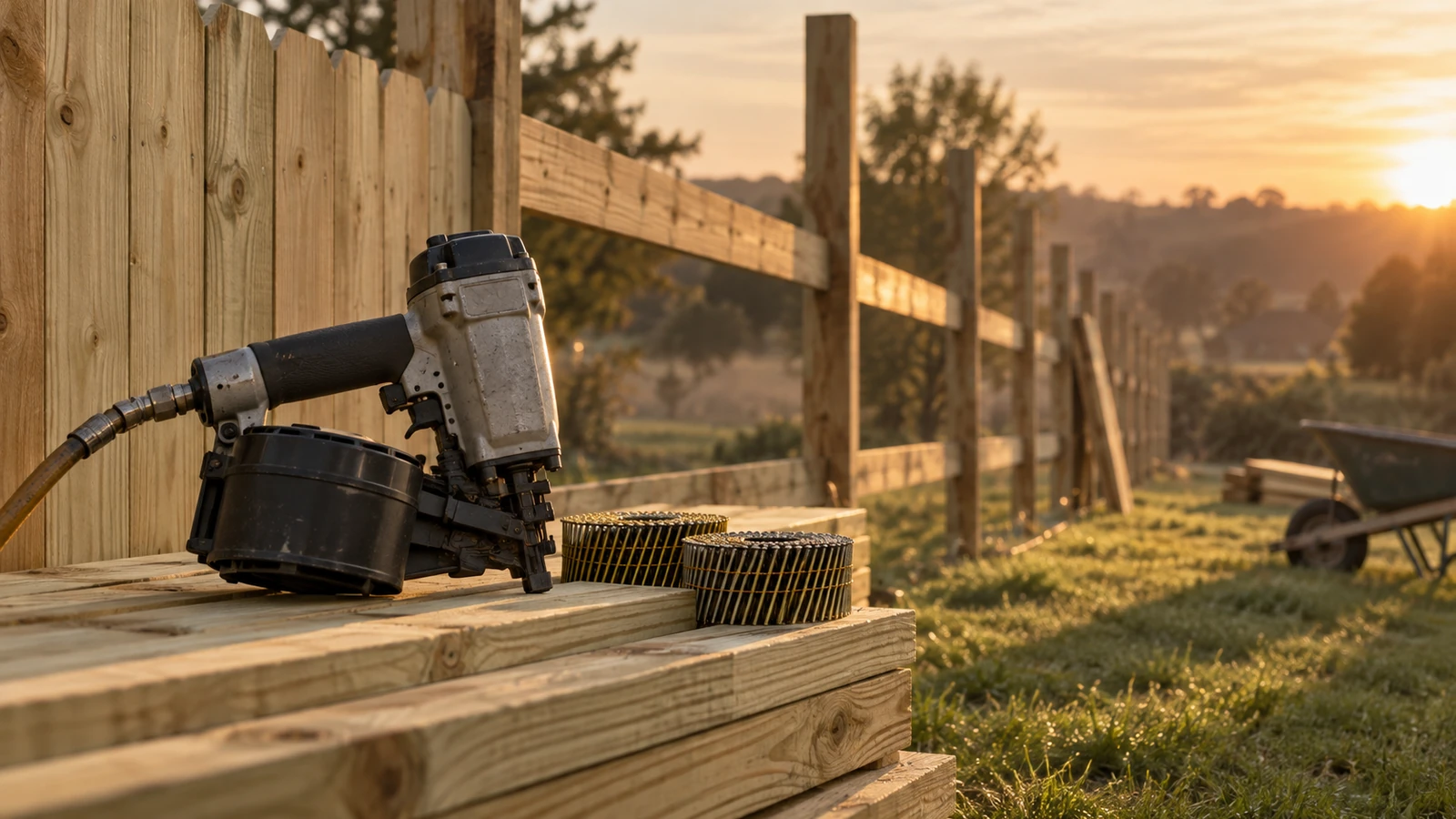
A picket fence is assembled in one afternoon and asked to behave across four seasons, and the fastener is the part that decides how gracefully it does that. Boards that are fixed tight in July can be under stress by the following February, and the gap that would have absorbed the movement is usually the one the installer removed because it looked untidy.
The choice among coil nails for fence pickets is not really about driving speed. It is about what the joint has to do once the wood starts moving, how the coating behaves in the exposure it was sold for, and whether the pattern can be repeated by a second crew on a second order.
Why a picket fence is a moving assembly
Timber takes on and gives off moisture with the weather, and it does so most aggressively in the thin sections used for pickets. Each board changes width slightly. Because the boards are fixed to rails rather than to each other, the fence can absorb that movement, provided each fixing leaves the board somewhere to go.
A fence that has no allowance is not stronger; it simply stores the stress until a board splits, a fixing pulls, or the line develops the gentle wave that tells a trained eye the assembly was driven tight.
Ring shank, screw shank or smooth: what a picket joint is asked to resist
A picket is loaded in a way that is easy to picture. Wind pushes at the face and tries to work the board off the rail. Seasonal movement tries to slide the board across the rail. Both forces are resisted by the shank, not by the head.
Ring shank nails are the usual answer for pickets because the rings engage the timber fibres and resist withdrawal, which is the failure that appears first on an exposed fence. Screw shank nails add rotation resistance where a board is likely to twist. Smooth shank nails are the cheapest option, and the one that comes back as a service call on a fence built with coil nails for fence pickets that were chosen on price alone.
Coating choice across the seasons
Coating is where a fence specification is usually decided, and where it is most often under-specified. The exposure of a picket one metre above the ground in a coastal town is not the exposure of a picket under a tree in a dry inland garden, and the two do not need the same wire.
| Exposure | Finish that suits it | What to expect over time |
|---|---|---|
| Dry inland, sheltered | Electro-galvanised | A dulled surface and slow, even weathering |
| General exterior, rain and frost | Hot-dip galvanised | A zinc layer that sacrifices itself before the steel does |
| Treated timber | Hot-dip galvanised or stainless | Slower attack from the preservative chemistry |
| Coastal or salt-treated roads | Stainless | The only finish that keeps its margin over a long service life |
Two finishes can look identical in a sample box and behave completely differently in a garden. Ask for the coating class in writing, and treat a change of coating as a change of product that deserves its own approval.
Leave room: gaps, spacing and the first summer
Movement allowance is the part of fence building that is easiest to explain and hardest to sell, because a fence built with visible gaps looks like a fence built badly. It is not. It is a fence built with a place for the boards to go.
| Element | How it moves | Allowance to build in |
|---|---|---|
| Picket width | Expands across the grain in damp weather | A small gap between boards that closes without touching |
| Rail to post | Shrinks along the length as it dries | End distance that leaves room for a fixing without breakout |
| Board to rail | Slides slightly as moisture changes | Nails set so the board is held, not clamped |
| Top of the line | Rises and settles with the ground | A fixing pattern that can be adjusted after the first winter |
Pickets, rails and the joint that takes the wind
The joint that fails first on an exposed fence is almost always the picket-to-rail connection, because it carries the wind load of the largest surface area. Two fixings per board per rail is the usual pattern, set at a third points across the board width, with both driven into the rail rather than one into a knot or a rail end.
Where a rail is fastened to a post, the fixing is doing a different job and should be chosen for it. Coil nails for fence pickets are the right part for the picket line; a rail-to-post connection that carries the whole fence in bending usually wants a structural screw with a defined shank.
Installing in rain, in frost, in a heatwave
- Fix dry boards slightly looser than wet boards, because the tighter gap belongs to the wet condition.
- Do not drive fixings into frozen timber; the fibres behave differently and the shank cannot engage them properly.
- In high summer, shade the stack of pickets so the boards being fixed are closer to their installed moisture content.
- Record the date of fixing, because the first winter will tell you whether the allowance was right.
- Treat the board ends and cut edges, which is where water enters before the coating is ever tested.
Coil nails for fence pickets checklist before the first run
The Forest Service wood handbook remains a useful reference for how solid timber behaves as moisture changes, and it supports what every fence crew already knows from the field: the wood moves, so the fixing has to allow it. A short pre-start list keeps that knowledge attached to the order, and it is the list ProAirNails asks for before quoting an exterior coil nail.
Confirm the board species and thickness, the rail dimensions, the exposure class, the coating, the shank type, the fixing pattern, the tool and the air pressure. Where the wire is galvanised, the ASTM specification for zinc-coated steel wire describes how coating weight is stated, which is the figure to compare between two quotations for coil nails for fence pickets. Then drive three trial boards and inspect the back of the rail for head pull and the face of the board for crush marks. Seven minutes of trial is cheaper than a re-fix along a boundary line.
What this guidance does not cover
Nothing here replaces the specification for a fence that carries a structural or planning obligation, and none of it decides an engineered post embedment or a wind load calculation. A finish recommendation from ProAirNails is not a corrosion guarantee, because the exposure on site is rarely the exposure in the drawing. Local conditions also vary more than any general rule, which is why the trial boards belong in the process rather than in the appendix.
FAQ
How many coil nails for fence pickets does each board need?
Two per rail for most installations, placed across the width of the board so the load is shared rather than taken at one point.
Are ring shank nails worth the extra cost?
On any exposed fence, yes. The rings are what resist the withdrawal that starts the failure.
Can I use the same nails for the rails and the pickets?
You can, but the joints do different work. The rail connection often suits a screw with a defined shank because it resists bending.
What gap should be left between pickets?
Enough that a board can expand without touching its neighbour. The right figure depends on species and thickness, so it is set from a trial.
Does galvanised wire work with treated timber?
Hot-dip galvanised is the usual minimum for treated timber, and stainless is the safer choice where the treatment is aggressive or the exposure is coastal.
Why do nails pull out of a fence after a year?
Usually because the board moved and the fixing had no allowance, or because the shank could not hold in the rail species being used.
Should the fence be built in summer or winter?
Either, provided the gaps are set for the wet season rather than for the day of installation.
How do I check nail depth?
Set the tool so the head sits flush without crushing the surface, and check the back of the rail for any spike that has passed through.
What tool suits a picket line?
A coil nailer with an adjustable depth setting. See the coil nail range for collation angles that match common tools.
What should I send a supplier for a quotation?
The species, thickness, exposure, coating requirement, tool, annual quantity and the fixing pattern you intend to use.
Send the build-up, not the part number
A fence quotation is only comparable when the joint is described, which is why a specification for coil nails for fence pickets starts with the build-up rather than the part number. Send the board species and thickness, the rail size, the exposure, the coating and the tool, and the reply can be a specification rather than a strip of nails. ProAirNails supplies coil nails, pneumatic nails and pneumatic staplers into exterior and furniture work, and the fastest route is a photograph of the joint with a tape measure in it. Start at Contact Us.