
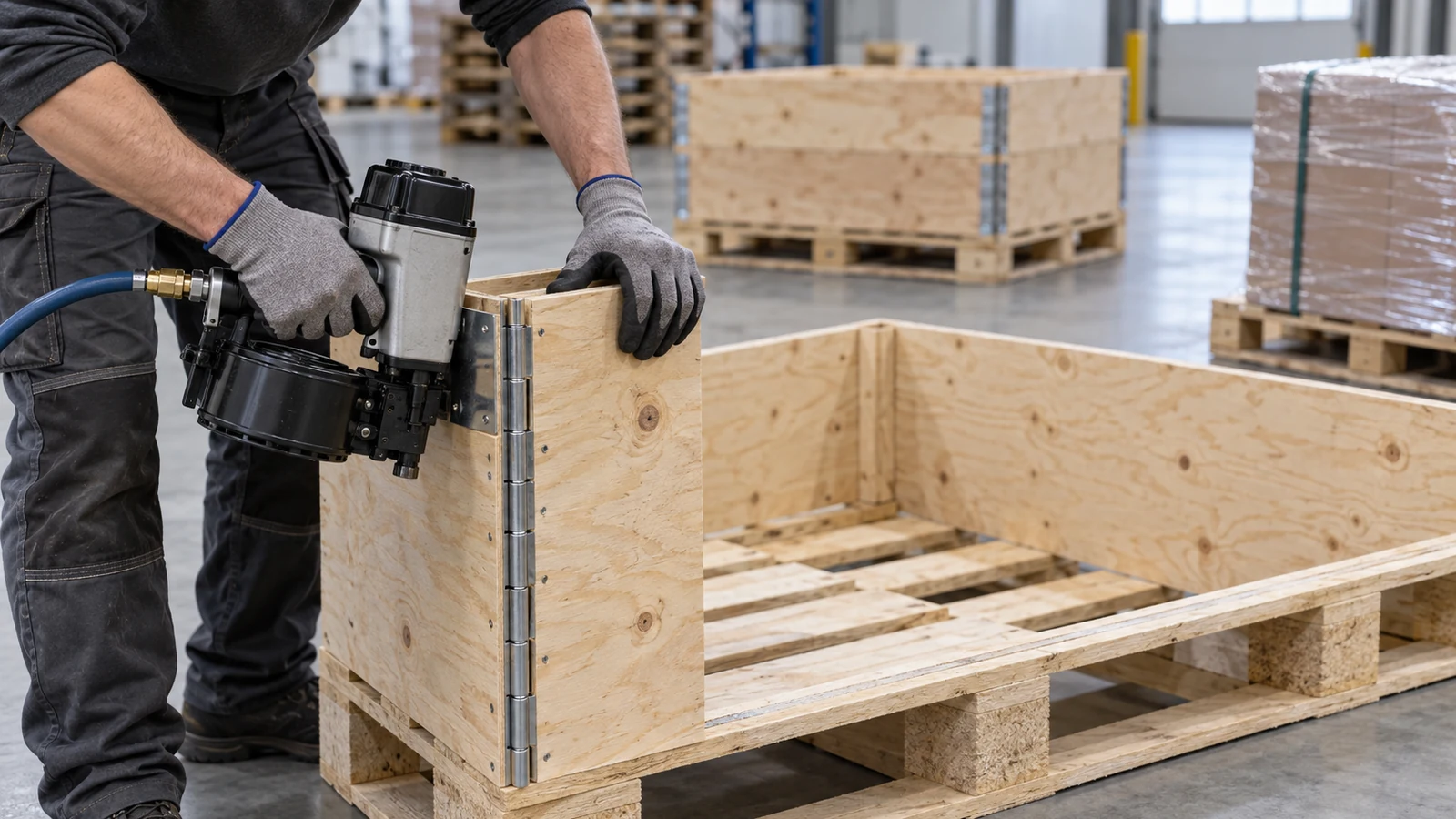
Coil nails for pallet collars are placed after the hinge, not before it. A collar is a hinged frame that has to fold flat for the trip home, so the hardware at each corner owns part of the board face. A nail pattern drawn from the outside of the board will collide with that hardware, and the fitter will move the nails rather than stop the line.
ProAirNails supplies coil nails to collar and pallet-box producers who measure their success in return trips rather than in first assemblies. That changes which questions matter, and it changes what has to be written on the collar drawing.
What coil nails for pallet collars actually hold
Three loads arrive at a collar corner. The board is pulled away from the hinge plate, the hinge is twisted as the collar folds and unfolds, and the corner post takes the stack weight above it. A coil nail can serve the first of those well, assists with the second, and has almost nothing to do with the third.
Separating the three is what turns a fastener request into a specification. The supplier needs to know which of them is being fixed by the nail and which are handled by the hinge, the post, or the banding.
The hinge sets the nail line
Hinge plates and their rivets sit on the outside face of the collar board, and the fold action sweeps through the inside corner. Both areas are keep-out zones for a fastener, which leaves a band of usable face along the middle of each board.
Measure that band on a real hinge rather than from a catalogue outline. Hinge models from different suppliers vary in plate length, and a collar program that changes hinge supplier without re-measuring the nail line is a program that will start producing split boards.
Board thickness and the leg that stops inside
Collar boards are usually thinner than pallet deck boards, and they are usually softwood, so the leg of coil nails for pallet collars has to be long enough to hold and short enough not to break out of the visible face. On a hinged frame the exit point is on the side that folds against the goods, which makes a breakout both a strength problem and a handling hazard.
Draw the section before choosing a length: board thickness, hinge plate thickness, and the direction the clinch is allowed to turn. If the drawing leaves no room for the clinch, the answer may be a shorter leg, a different shank, or a change in how the hinge is fixed, and none of those conclusions belongs to the supplier alone.
Corner posts and the load that leaves the board plane
On taller collars, the stack weight passes through corner posts rather than through the panel faces. A post that is only fastened to the panel will lean under load, and the panel will take a bending force it was never specified to carry.
Ask what locates the post before asking what holds the panel. If the answer is "the hinge and the banding", write that down, because it means coil nails for pallet collars are not the load path and should not be specified as one.
Treatment, marking, and the board you are allowed to change
Collars travel as wood packaging material, so the boards normally have to be treated and the unit marked before it enters international trade. The ISPM 15 standard published by the IPPC is the reference your packaging supplier works to, and it is worth reading before a repair program is agreed.
The practical consequence for a buyer is that replacing a board is not a carpentry decision alone. A repair that swaps treated material for untreated stock, or that removes a marked component, can take the unit out of compliance even though the fastener work looks correct.
Keep three things separate when a collar program is specified, because they are decided by different people:
- The treatment and marking status of the wood, which the packaging supplier owns.
- The hinge and post detail, which the collar designer owns.
- The number, series and length of coil nails for pallet collars, which is settled by a trial corner.
Repair rules for a returnable collar
Returnable collars fail in a small number of predictable places, and the repair standard should name them in advance. Without that standard, every damaged collar becomes a judgement call at the dock.
| Condition found | What it means | Decision to record |
|---|---|---|
| Loose hinge plate with sound board | Fasteners have lost grip in the original holes | Re-fix to a new line, or reject if the hinge is deformed |
| Split board at the nail line | The leg or the pattern is wrong for the thickness | Replace board and revise the fastener specification |
| Worn or crushed board edge | Handling damage, not fastener failure | Trim and re-machine if the marking is preserved |
| Bent or seized hinge | Hardware at the end of its life | Replace hardware; re-check the fold clearance |
| Missing or damaged mark | Compliance status is no longer proven | Re-treat and re-mark, or retire the unit |
Height, stacking, and the hinge load path
Extra collar height adds board area but also adds a longer lever at each corner. A stack that was stable at one height can begin folding the top hinge assembly at another, and the symptom is usually blamed on the fasteners because they are the parts that come loose.
Test at the height the customer will actually use, and add the sideways shove that a forklift produces. Lifting a collar straight up tests the base; dragging and cornering test the hinge line that the fasteners sit on.
Inspection and the repair log
A repair program for coil nails for pallet collars lives or dies on its records, because the second repair of the same corner is the one that reveals the pattern. Keep the log short enough that it is genuinely filled in.
ProAirNails asks buyers to keep the failed corner itself as well as the record, because a photograph cannot show how the hinge moved or where the board grain ran, and those are the details that decide the next specification.
| Field | Why it earns its place |
|---|---|
| Collar identification and trip count | Shows whether failures cluster early or late in service life |
| Corner position | A single corner failing repeatedly points at the hinge, not the fastener |
| Fastener series and length used | Proves the repair matched the original specification |
| Board and hinge replaced | Keeps treated-material and marking status traceable |
| Photograph of the failed corner | Settles disputes that a written description cannot |
The ASTM F1667 driven-fastener specification gives an incoming inspection a common vocabulary for dimensions and finishes, which is useful when a repair line has to prove it used the approved part. It does not certify a hinge, so the hardware still has to be checked on its own.
FAQ
Do coil nails for pallet collars need a coated finish?
It depends on the return cycle. A collar that comes back damp, or that is stored outdoors between trips, needs a finish that survives it, so state the service condition in the enquiry.
What length of coil nail suits a pallet collar?
It depends on board thickness and hinge plate thickness. Choose the shortest leg that still crosses into the load-bearing member without breaking out of the folding face.
Can a collar be assembled with staples instead?
Often yes, when the load path is the hinge and the panel only has to stay located. The choice follows the joint design, not the tool that happens to be on the bench.
Why do nails keep loosening at the same corner?
Repeated failures at one position usually indicate hinge deformation or a folded clearance problem rather than a fastener defect.
Does replacing a board affect the compliance marking?
It can. Ask your packaging supplier what the repair rule is before a board is swapped, because treated material and marks are part of the unit's status.
How do I check a hinge keep-out zone?
Measure a production hinge, not a drawing outline, and mark the usable band on the collar drawing that the bench actually uses.
What causes a split along the nail line?
A leg that is too long for the section, nails set too close to the board end, or a pattern that puts two fasteners in the same grain line.
Is a heavier coil nail always better for a returnable collar?
No. A heavier fastener can split thin softwood boards and produce a repair that outlives the collar it was meant to save.
What should the collar drawing show?
Board thickness, hinge model, keep-out zone, fastener series and length, corner post detail, and the height the collar is rated for.
What should a collar enquiry include?
The drawing, board material and treatment, hinge model, intended stack height, return cycle, nail series you intend to trial, and the delivery schedule.
Send the collar drawing, not the series name
ProAirNails supplies coil nails for pallet collars and works with buyers on coil nails, air staplers, and other pneumatic nails for pallet, collar, and packing programs. The fastest answer comes from a request that includes the collar drawing, board thickness, hinge model, stack height, and the return cycle you are designing for.
Send it through Contact Us with a photograph of a failed corner if you have one. A failed corner photographed from both faces usually removes a week of questions.