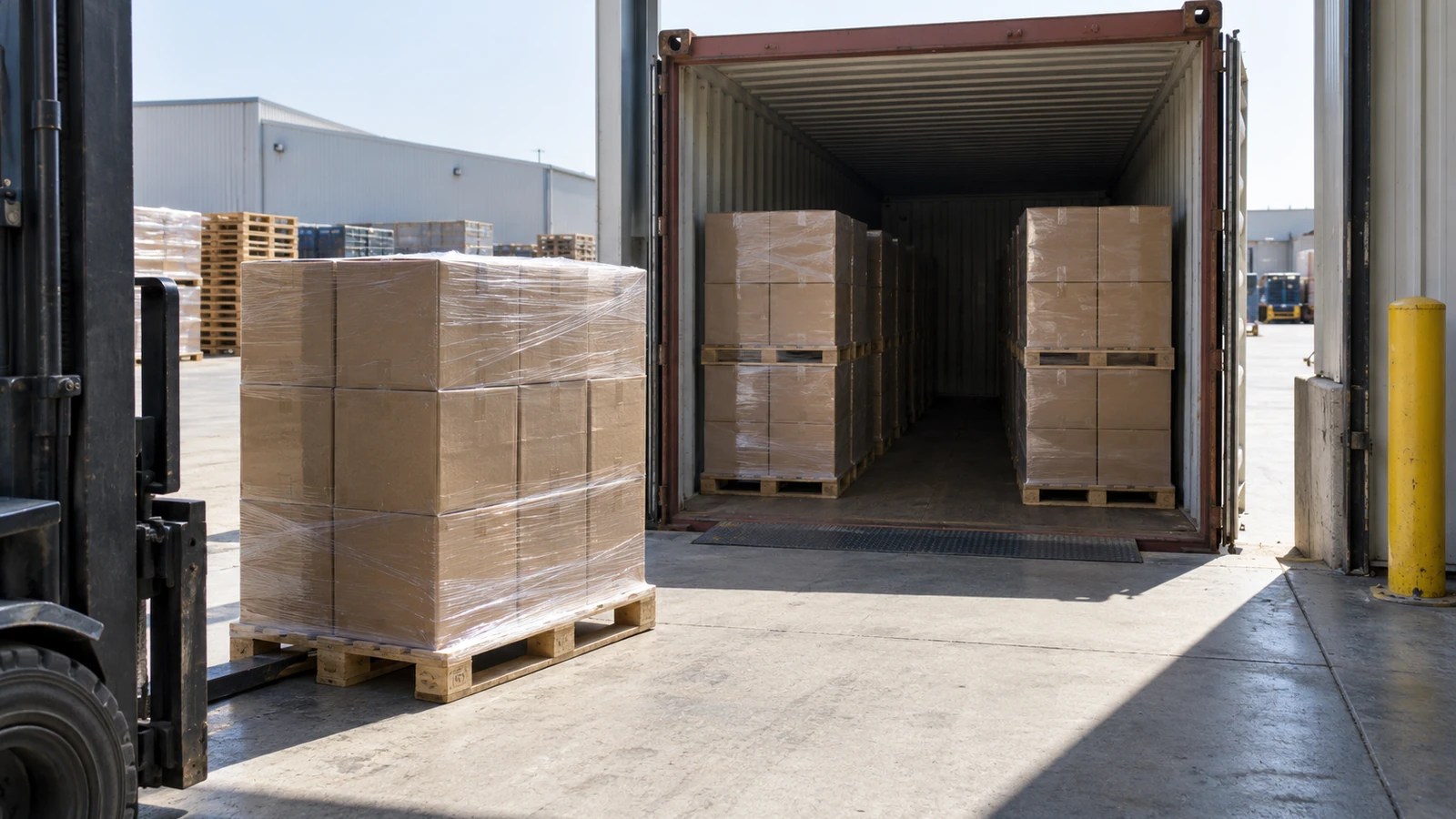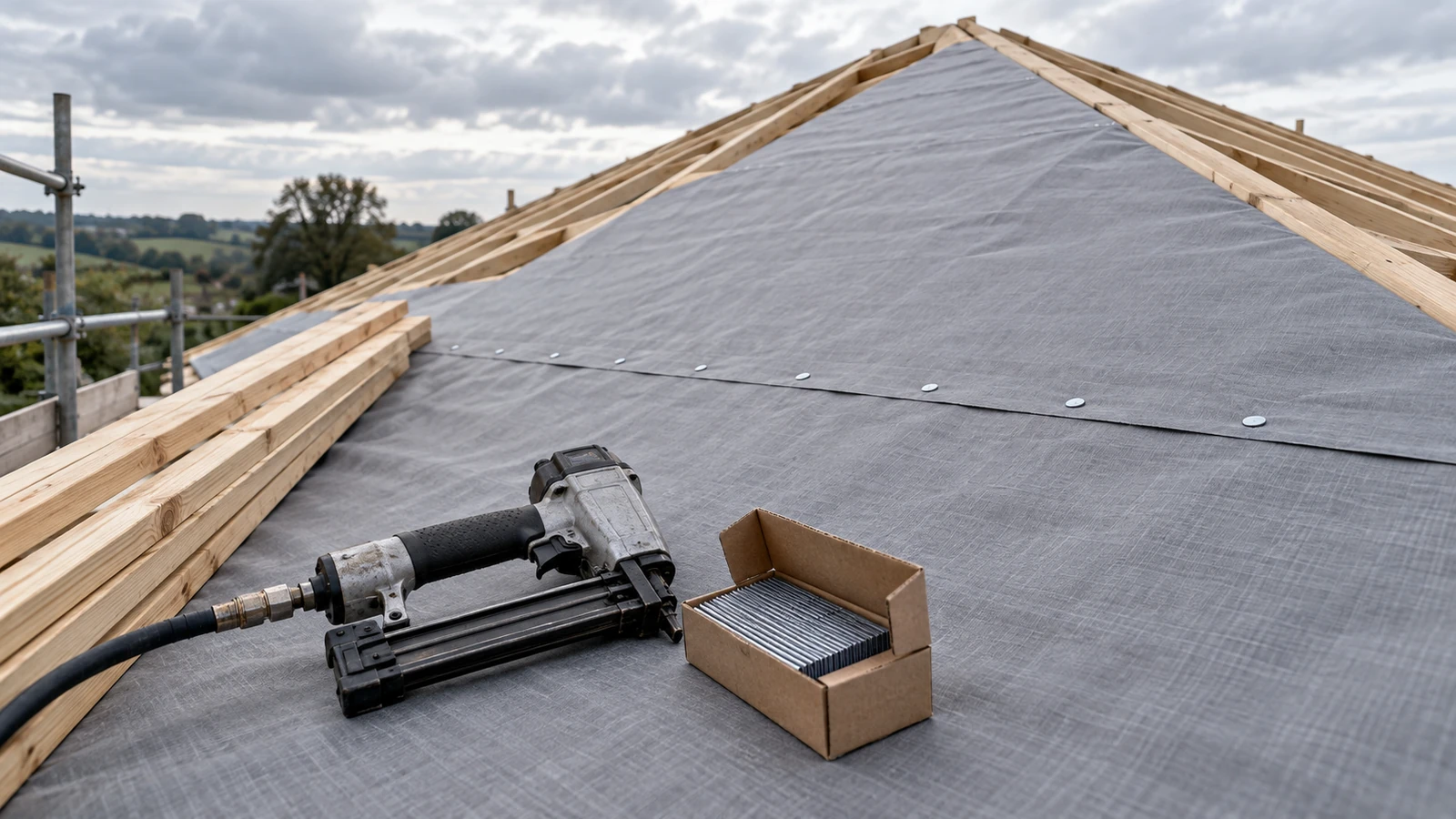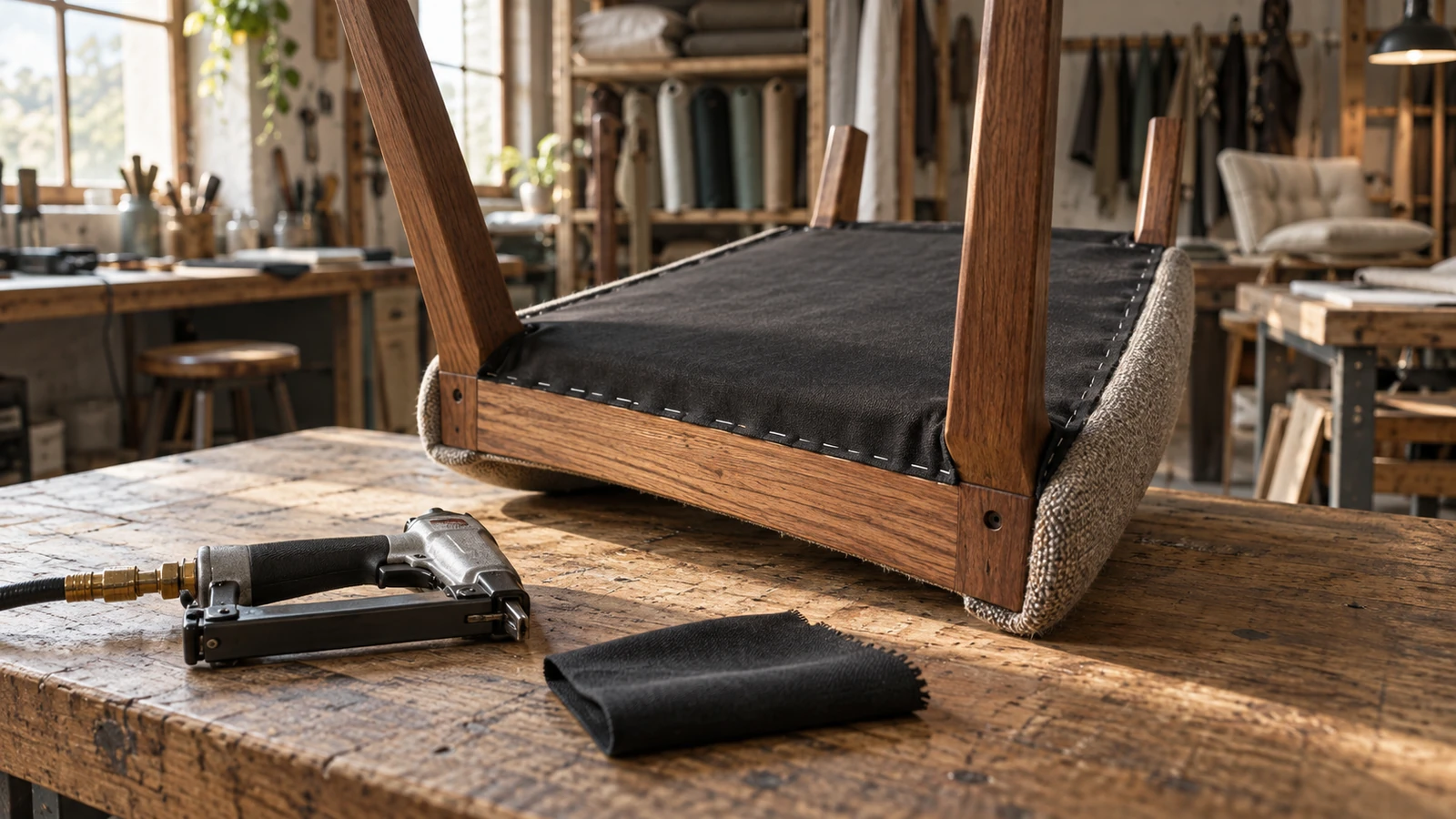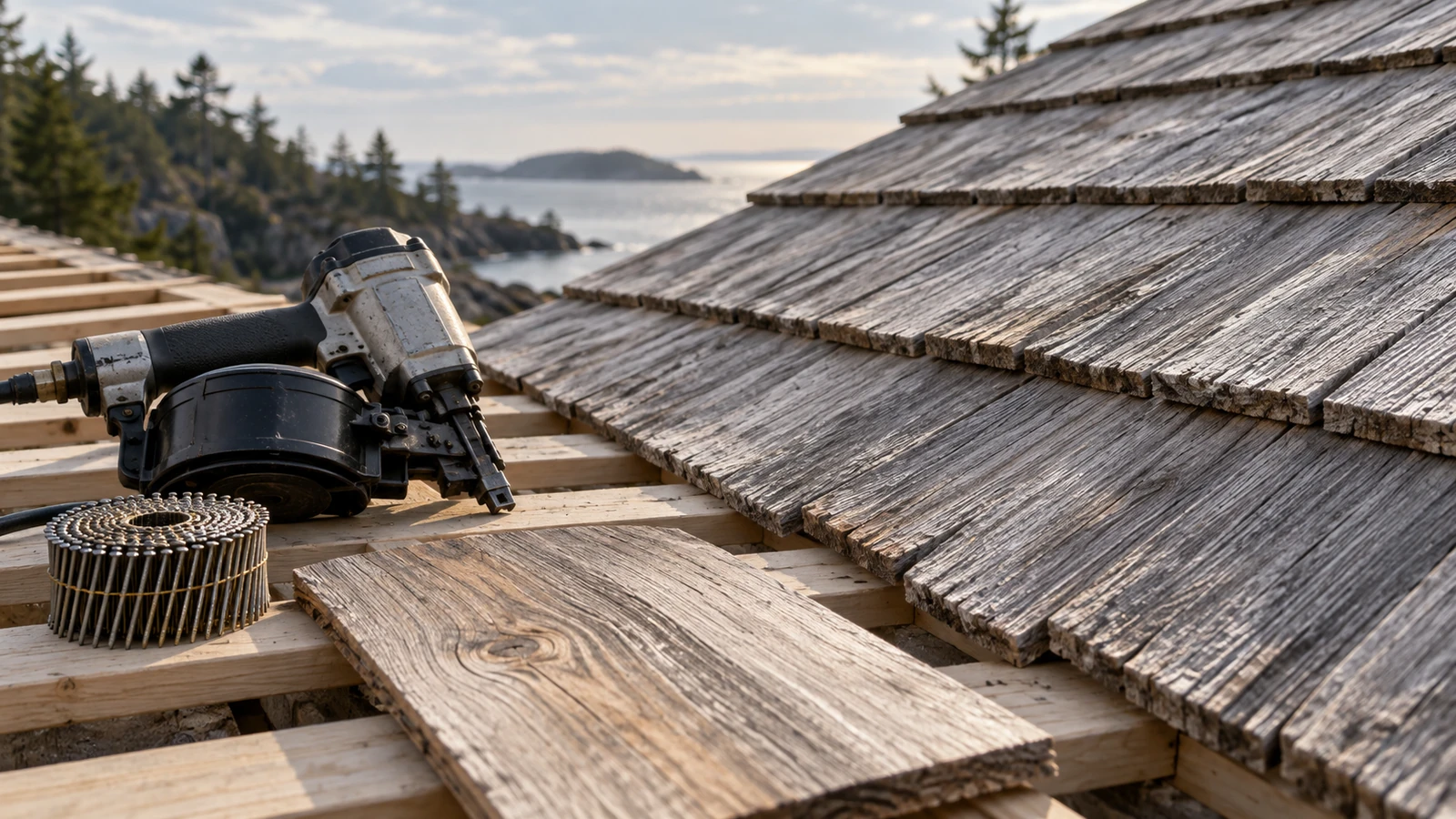

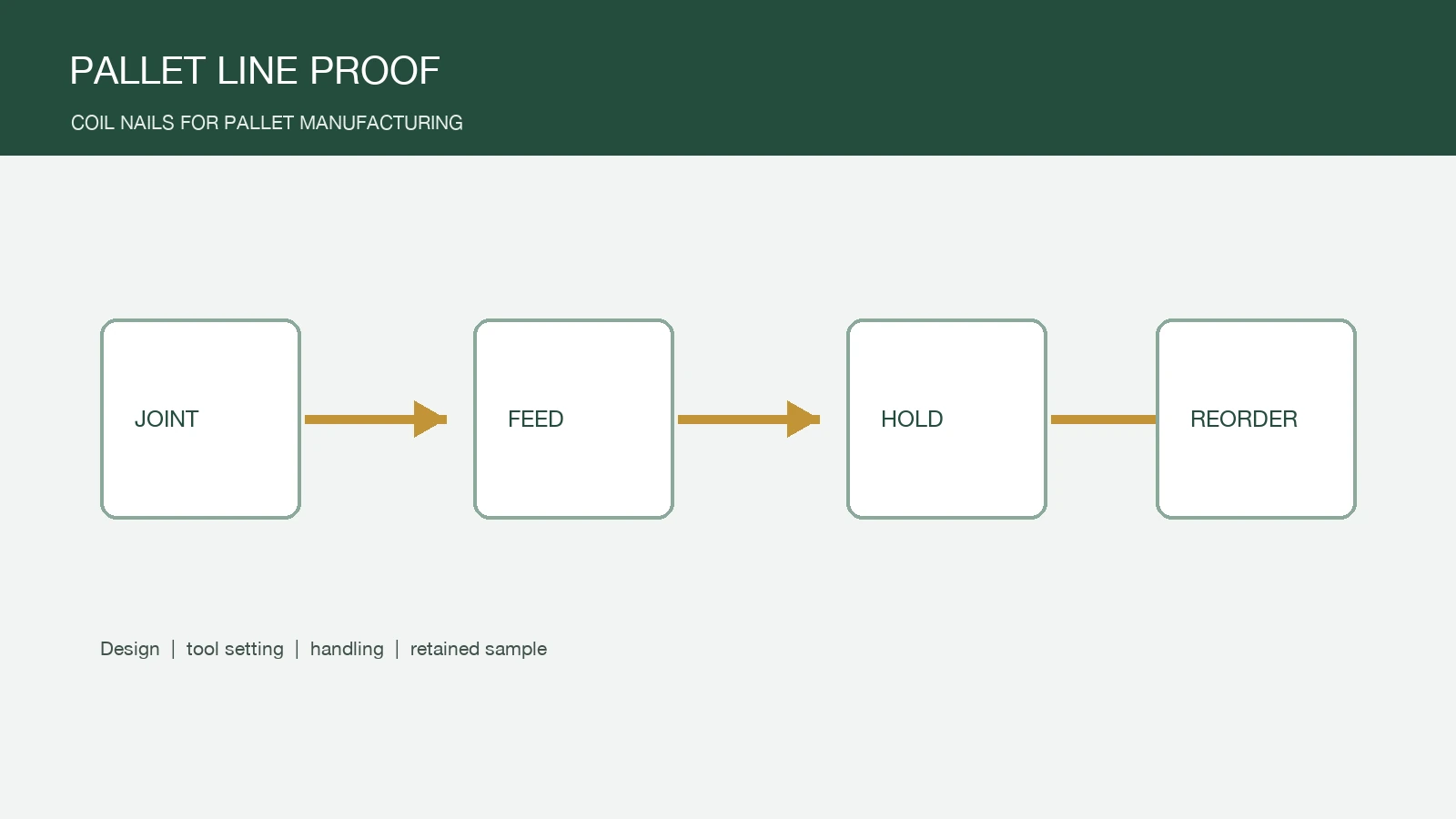
A pallet line proves a coil nail choice by repeating the joint, not by producing one attractive sample. When a pallet maker evaluates coil nails for pallet manufacturing, the useful trial follows the same timber, nailer, work sequence, and packing route that the production team will use after approval. That is where feeding stability, head seating, holding behavior, and coil handling meet.
ProAirNails suggests treating the first run as a controlled commissioning exercise. Record the pallet joint, the nail specification, the tool, the air setting, and the operator sequence before counting good shots. This makes the result useful to purchasing and production instead of leaving it as a photograph with no repeatable conditions.
Draw the joint before selecting the coil
Start with the actual pallet design. Note deck-board thickness, stringer or block material, moisture condition, edge distance, and the number of shots per joint. A fastener that works in dry softwood may behave differently in dense hardwood, repaired boards, or timber that has absorbed moisture during storage. The drawing does not need to be a complex engineering file. It needs enough detail to show where the shank must hold and where a point could exit.
Define the job in a short trial note: joint name, board stack, nail angle, target penetration, and acceptable surface damage. If the design changes later, open a new trial record. The same coil should not silently cover a longer board, a different block, and a different drive angle simply because the carton label looks similar.
Release coil nails for pallet manufacturing by evidence
Use the phrase coil nails for pallet manufacturing as a defined sample scope, not as a promise that every pallet joint will behave identically. The release note should name the approved timber, joint, nailer, and handling check so a later buyer can see exactly what the sample proved.
Separate feeding from holding in the test plan
| Question | What to observe | Record with the sample |
|---|---|---|
| Will the coil feed? | Magazine loading, indexing, weld or wire behavior, empty-shot response | Nailer model, coil format, interruptions, and adjustment made |
| Will the nail seat? | Head position, point entry, bent shanks, timber splitting | Air pressure, driver condition, joint position, and photos |
| Will the joint hold? | Withdrawal path, board lift, loose fibers, and movement after handling | Test direction, sample age, load method, and verdict |
Keeping these questions separate prevents a fast feed from hiding a weak joint. It also tells the supplier what to correct. A feed interruption points toward collation, angle, coil diameter, or tool fit. A clean feed with poor holding points toward length, shank form, timber selection, or joint geometry.
- Mark the first, middle, and final coils from the run.
- Keep a retained strip or coil label with every test board.
- Photograph both the driven face and the back of the joint.
- Log the operator and tool setting so a second shift can repeat the trial.
Match shank form to the pallet's failure path
Ring shank and screw shank designs create different resistance patterns. A ring shank can provide useful withdrawal resistance in many wood joints, while a screw shank can add rotation and bite during installation. Neither label is a substitute for a trial in the actual timber. The buyer should decide whether the key risk is boards lifting, nails loosening during forklift handling, or a fastener splitting the edge.
For coil nails for pallet manufacturing, specify more than shank type. Confirm length, wire diameter, head profile, point, collation angle, weld or wire arrangement, coating, and coil count. If an order allows several lengths, assign a separate code to each one and retain a sample coil for the reorder review.
Run a three-stage pallet trial
Stage one is a setup check. The operator loads one coil, drives a small sequence, and confirms indexing, depth, and visible damage. Stage two is a production-like run with the same pauses, board changes, and nailer movement used on the line. Stage three is a handling check after the pallet is squared, stacked, moved, and inspected. A coil that behaves well on a bench can still create trouble when the tool is carried at an angle or the pallet is turned quickly.
| Stage | Minimum sample | Release question |
|---|---|---|
| Setup | One coil and a defined joint sequence | Does the tool feed and seat without immediate correction? |
| Production-like run | Several joints across the normal board mix | Does the process stay stable when the operator and material move? |
| Handling | Completed pallet after stacking or transport simulation | Does the joint remain tight with no new split or proud head? |
Make the withdrawal check honest
A simple pull check can compare samples, but it should be described accurately. State whether the force is applied along the shank, across the board, or by separating the pallet members. Record whether the timber failed first or the nail moved first. Do not turn one number into a universal strength promise; wood species, moisture, grain direction, spacing, and nail placement all affect the result.
ASTM F1667/F1667M provides a reference vocabulary for driven nails and staples, including dimensional categories; buyers can review the ASTM driven fastener specification when setting a shared specification. A quality system reference such as the ISO 9001 requirements page is useful for discussing records and corrective action, but neither document replaces a pallet-joint trial.
Control coils through packing and storage
Coils are vulnerable to deformation when cartons are over-compressed, dropped, or stacked with uneven weight. Check the coil diameter, weld or wire condition, carton dividers, count, label, and pallet pattern. Storage notes should cover humidity exposure and the time between receipt and use. When a coil is held for investigation, isolate it with the original label rather than transferring it to an unmarked bin.
ProAirNails helps buyers compare coil nails, review related pneumatic nails, assess brad nails, and organize an RFQ through Contact Us. For a pallet producer, the most useful deliverable is a retained sample plus a clear record of the joint that it actually passed.
Set the reorder gate
Before the first repeat order, compare the new carton with the approved record: product code, dimensions, shank, coating, coil count, label artwork, and lot identity. Ask the supplier to disclose changes to wire, tooling, collation, coating, packaging, or inspection. A reorder gate gives the pallet team a chance to test a change before a full container reaches the floor.
In short, coil nails for pallet manufacturing should be approved as part of a joint and a process. The buyer gains a stronger decision when feeding, seating, holding, packing, and change control are reviewed together.
FAQ
What should I define before buying coil nails for pallet manufacturing?
Define the pallet joint, timber type, board thickness, nail angle, target penetration, nailer, coil format, and the failure mode the trial must prevent.
Are ring shank or screw shank coil nails better for pallets?
They create different resistance patterns. Test both in the actual timber and judge the failure path that matters to the pallet design.
How many coils belong in a first trial?
Use enough material to cover setup, a production-like run, and a handling check. Mark the first, middle, and final coils when possible.
Why can a coil feed well but still fail?
Feeding checks magazine and collation behavior. Holding depends on length, shank, timber, spacing, grain, and joint geometry.
Should the pallet be tested after stacking?
Yes. Movement, stacking, and handling can reveal loose joints or board splits that are not visible on a stationary bench.
What should appear on a coil carton?
Keep the product code, dimensions, shank or finish description, coil count, lot identity, and handling instructions visible and traceable.
Can one approved coil cover several pallet designs?
Only when the joint, timber, tool, spacing, and loading conditions are equivalent and the evidence covers the full range.
What does a useful withdrawal check record?
Record the force direction, sample construction, timber condition, nail placement, first failure, and any deviation from the planned method.
How should a supplier handle a coating or tooling change?
The change should be identified, contained, reviewed against the approved sample, and released only after the buyer decides whether a new trial is needed.
Can ProAirNails support pallet nail sampling?
ProAirNails can align product dimensions, coil format, packaging details, and application questions so a B2B buyer can document a defined release.