
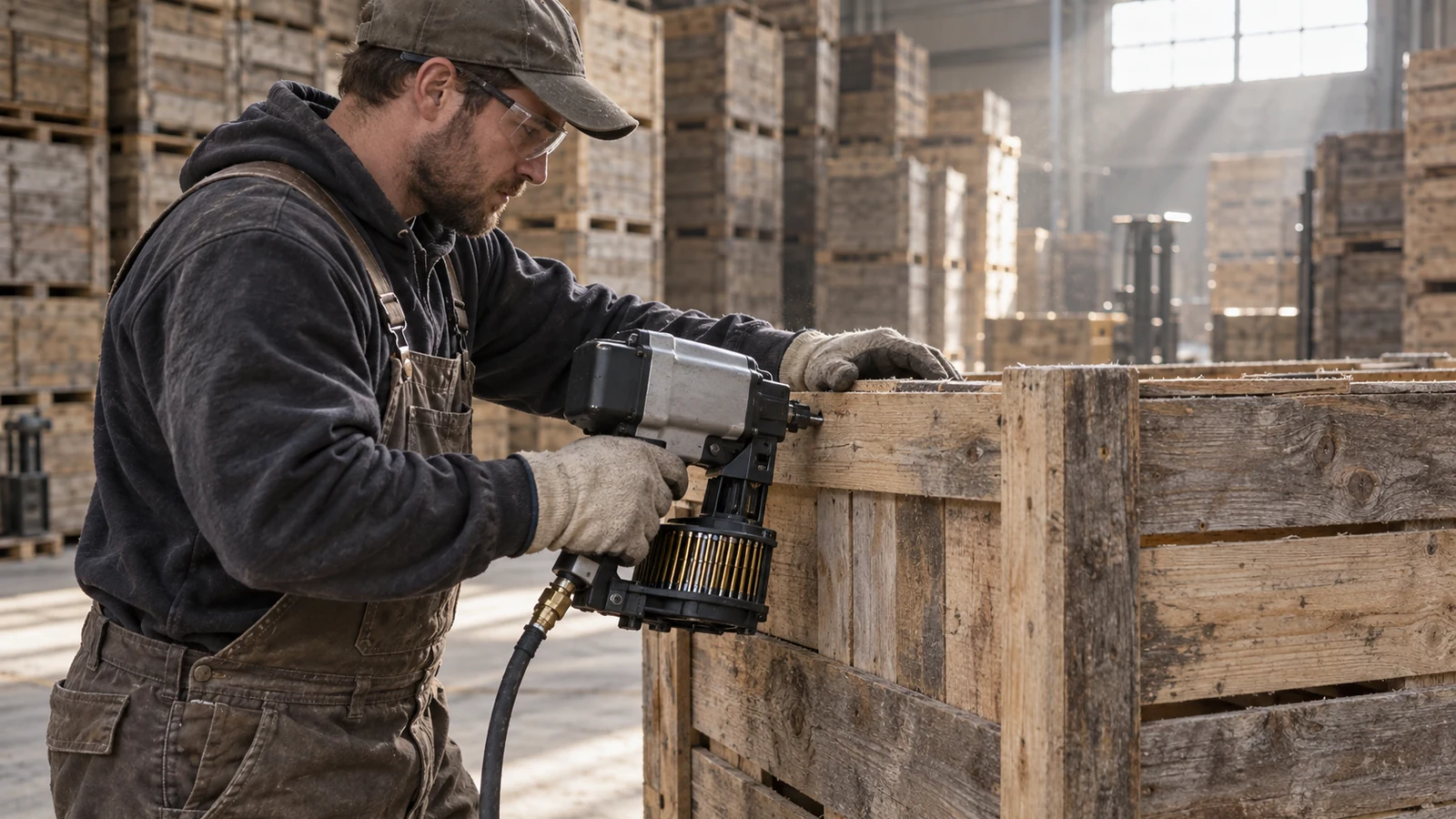
Coil nails for reusable wooden crates should be approved for a lifecycle, not just a first build. Returnable crates are opened, stacked, moved, stored, repaired, and filled again. The timber can carry old holes or crushed fibres by the second trip, and a fastener that feeds well in a new panel may not behave the same way in a repair bay.
ProAirNails recommends a four-stage record: first assembly, dispatch handling, return inspection, and approved repair. The record should identify the crate design, component, nailer, coil, visible damage limit, and release owner at every stage.
Define the return cycle before choosing the coil
Start with the crate's job. Note what it protects, how it is lifted, whether it is nested or stacked, and whether the customer expects repair or replacement after a return. A reusable crate is not automatically a regulated wood-packaging unit, but international movement may bring phytosanitary requirements that must be handled separately.
The IPPC guide to ISPM 15 implementation discusses treatment, marking, manufacture, repair, reuse, import inspection, and non-compliance. Use the applicable national program and customer instructions; a nail choice does not authorize a mark or prove treatment status.
Map coil nails for reusable wooden crates by component
| Crate component | Fastener job | Lifecycle risk |
|---|---|---|
| Deck or base rail | Hold the load path while the crate is lifted | Board lift, impact damage, or loose edge |
| Side slat | Keep the wall aligned during stacking | Split, proud head, or snag on a neighboring crate |
| Corner cleat | Transfer movement between panels | Old hole overlap or a short engagement path |
| Repair board | Restore the declared crate geometry | Unknown timber condition or mixed fastener history |
Give each component a placement rule. Repeated use makes “same crate” an unreliable description if a corner has already been repaired or a slat has been replaced with a different thickness.
Test a new crate and a returned crate
The first sample checks feed, seating, and joint geometry. The return sample checks how the same joint behaves after handling and storage. Mark the returned board so the test cannot be mistaken for new timber. Inspect old holes, fibre crushing, moisture exposure, and previous fastener remnants before the tool is loaded.
- Record coil diameter, count, wire or weld condition, point, head, shank, and finish.
- Use the production nailer, driver, magazine, pressure, and operator route.
- Test both straight access and the approved repair posture.
- Photograph the front, back, edge, and any previous hole pattern.
- Retain the carton label and the repair disposition with the sample.
For coil nails for reusable wooden crates, separate feed interruptions from timber failures. A double feed belongs to the magazine or collation investigation; a split around an old hole belongs to the joint or material investigation.
Use handling events as checkpoints
| Checkpoint | What to recreate | Release evidence |
|---|---|---|
| Assembly | Panel alignment, nail placement, and closure | Joint photos and setup record |
| Dispatch | Stacking, lifting, wrapping, and loading route | Damage and snag inspection |
| Return | Opening, unloading, cleaning, and storage | Old-hole and fibre-condition notes |
| Repair | Component replacement and final handling | Repair ticket and new lot identity |
A bench pull can compare samples, but it does not reproduce fork entry, corner impact, vibration, or a return operator's access. State the test direction, timber, moisture condition, and first failure instead of publishing one number as a universal crate rating.
Keep packaging and phytosanitary records separate
Packaging quality asks whether the coil, carton, label, and pallet arrive usable. Phytosanitary compliance asks whether the wood packaging material followed the applicable treatment and marking rules. One record should reference the other when necessary, but the two decisions should not be collapsed into “the crate passed.”
The ASTM F1667 driven-fastener reference supports common fastener language for dimensions, material, and finish. It does not test a reusable crate's return cycle, so the physical crate trial remains the controlling application evidence.
Build the reorder around the failure log
At reorder, compare the approved coil and carton with the new lot: dimensions, shank, point, head, finish, collation, coil diameter, count, label, and packaging. Retain a sample from the first, middle, and final shipment positions when possible.
ProAirNails can help buyers compare coil nails, review pneumatic nails, connect the crate project to staples, and submit a return-cycle RFQ through Contact Us. Include crate drawings, component thickness, tool model, repair rule, treatment or marking responsibility, quantity, pack format, and destination.
The approval for coil nails for reusable wooden crates should state which return history and repair boundary it covers. If the crate design, timber source, handling route, or compliance program changes, reopen the affected gate.
Track repair evidence by crate generation
Give each crate generation a simple record that links the component, old-hole condition, coil specification, tool setting, repair decision, and release date. This lets ProAirNails and the buyer compare a new assembly with a returned repair without treating every damaged crate as the same test.
FAQ
Why are coil nails for reusable wooden crates different from new-crate nails?
Return cycles introduce old holes, crushed fibres, moisture history, repair boards, handling impacts, and a different tool posture.
What should the lifecycle record contain?
Record new assembly, dispatch handling, return inspection, repair rules, fastener lot, tool setup, damage limits, and release owner.
Can one coil cover every crate component?
Only when component thickness, joint path, access, timber, and lifecycle evidence are equivalent and included in the approval.
Should a returned crate be tested?
Yes. Use a representative returned component to check old holes, fibre condition, seating, and the permitted repair route.
Does an ISPM 15 mark prove the nail joint is sound?
No. Treatment and marking belong to a phytosanitary program; joint strength and repair acceptance need separate evidence.
Who controls an ISPM 15 mark?
The applicable national plant protection authority and approved program control that decision; confirm authorization before marking or repair release.
What should be separated in a failure log?
Separate feed interruptions, nail defects, timber damage, placement errors, handling damage, and marking or documentation issues.
What handling events matter?
Include lifting, stacking, wrapping, loading, unloading, cleaning, storage, and the actual repair movement used by the program.
What should a reusable-crate RFQ include?
Send crate drawings, component thickness, return history, tool, coil specification, repair rule, quantity, packaging, destination, and schedule.
When should the approval be reopened?
Review changes to timber, design, coil, tool, handling route, repair method, packaging, treatment, marking, or customer acceptance rules.