
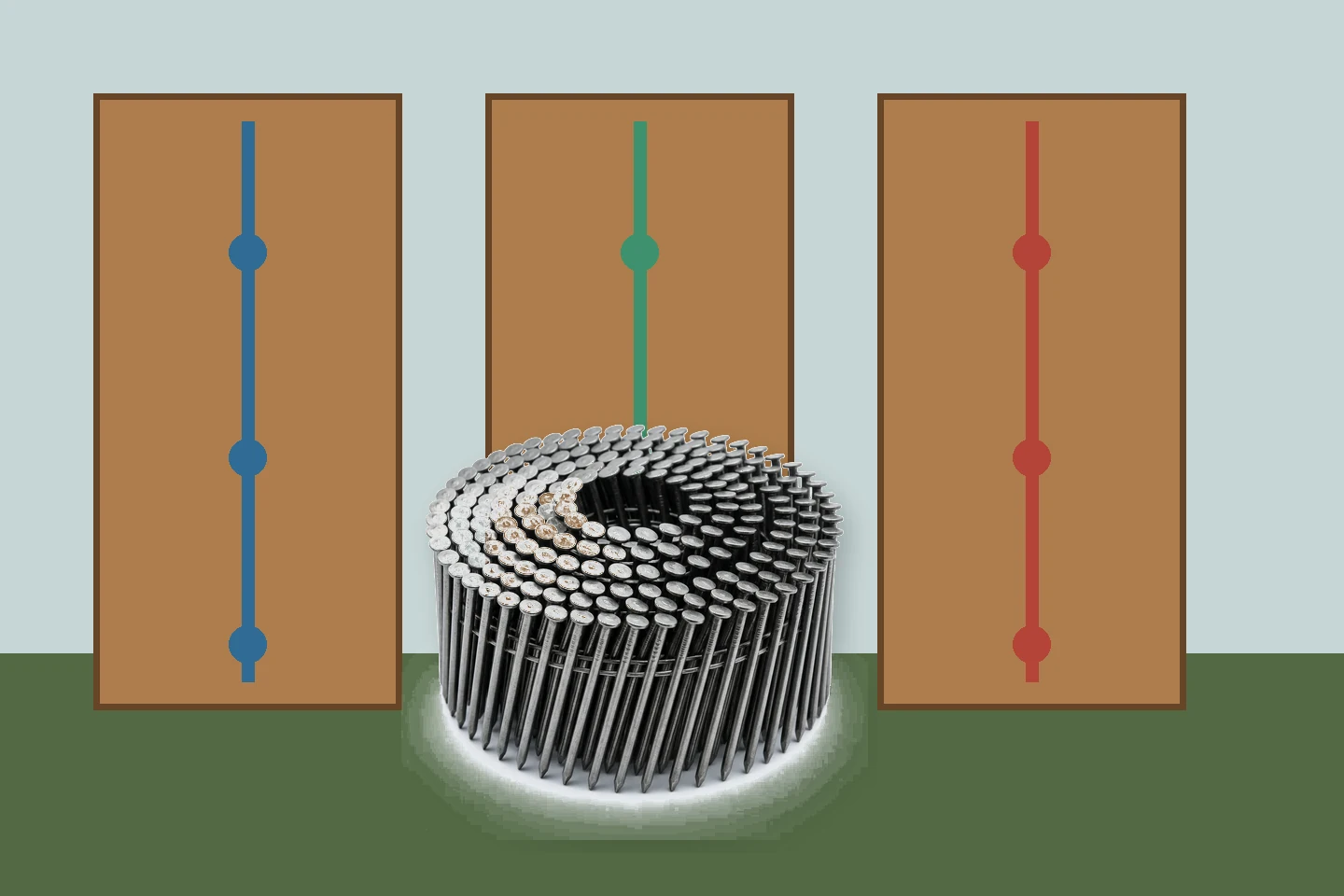
Select coil nails for timber fencing by separating the ground, field, and top exposure lines, then validating the actual wood, joint, finish, tool, pattern, and environment. One nominal fence description can hide major differences in moisture, end grain, splash, drying, wind, and inspection access.
ProAirNails recommends an exposure-line schedule so each joint has a documented fastener and evidence route rather than one informal site habit.
Line 1: define the ground-zone boundary
Record clearance, splash, vegetation, drainage, post and rail condition, end-grain proximity, preservative treatment, and local design requirements. Do not assume a fastener coating corrects poor drainage or prohibited construction details.
Line 2: map the field-zone joints
Identify board-to-rail connections, board width and thickness, rail material, edge distance, spacing, gaps, grain, knots, moisture, and expected movement. Mark every approved nail location and missing-fastener rule.
Line 3: challenge the top edge
Top edges can see end-grain moisture, direct weather, caps, cuts, and greater visual scrutiny. Test splitting, seating, staining, protrusions, and cap or trim interaction separately from easy central joints.
Compare requirements by line
| Exposure line | Priority evidence | Common oversight |
|---|---|---|
| Ground | Moisture route and material compatibility | Treating drainage as a nail issue |
| Field | Pattern, movement, feed, drive | Ignoring wood variation |
| Top | End grain, finish, appearance | Copying center-board settings |
| Transitions | Gates, corners, caps, repairs | No separate joint approval |
Match shank, point, and finish to design
Compare only candidates permitted by applicable project requirements. Record shank, point, dimensions, head, material, finish, collation, wood treatment, exposure, and compatibility. Do not make unsupported corrosion-life or structural claims from appearance alone.
Run a line-specific driving trial
| Measure | Count | Release use |
|---|---|---|
| Feed | Skips, doubles, jams | Production yield |
| Drive | Depth, bend, head damage | Joint acceptance |
| Wood | Split, crush, breakout | Pattern and setting |
| Assembly | Gap, movement, protrusion | Finished inspection |
Use named tools, approved settings, normal operators, realistic pace, and representative wet and dry wood conditions allowed by the project.
Inspect completed fence sections
- Verify pattern and missing-fastener limits.
- Check every exposure line.
- Record splits, protrusions, overdrive, and stains.
- Inspect gates, corners, repairs, and transitions.
- Retain results by wood and fastener lot.
Keep safety and engineering in scope
Follow tool manuals, site procedures, and applicable design requirements. Use the NIOSH nail gun safety guide as broader safety context. This article does not replace engineering or local code decisions.
Protect coils before they reach the fence
Specify coil count, carrier, orientation, cartons, labels, lots, pallet restraint, and moisture protection. Inspect deformation and corrosion at receipt, then run a short feed trial before release. Clarify international delivery duties with the ICC Incoterms resource where relevant.
Build inspection timing around exposure
Inspect at installation, after an agreed conditioning period, and after representative weather exposure when the validation plan requires it. Record wood movement, staining, raised heads, splits, and joint changes without claiming a short trial predicts unlimited life.
Approval of coil nails for timber fencing should identify the exact exposure line and tested boundary.
Review installed yield and callbacks
Compare unit price with usable coils, feed events, tool clearing, split boards, repairs, inspection, installation pace, replacement, and callbacks. Use actual rates per accepted fence section.
Scale the pilot across fence variation
Include representative ground, field, top, gate, corner, and repair locations; different wood lots and moisture conditions; multiple tools and qualified installers; and normal setting variation. Use ordinary coils selected from several boxes. Define which single-event failures, such as a dangerous protrusion or uncertain material compatibility, block release.
A pilot for coil nails for timber fencing should report accepted fence sections per coil, not only the number of nails driven.
Separate product approval from project approval
Receiving can verify coil identity, dimensions, finish, collation, count, labels, and packing. The project must still approve design, wood treatment, exposure, pattern, tools, installation, and inspection. Review ProAirNails coil nail options against the controlled joint schedule.
Use complaints as exposure-line evidence
For staining, raised heads, splits, loose boards, or corrosion concerns, record exact line, joint, wood, treatment, fastener lot, installation date, environment, maintenance, and timeline. Compare retained samples and unaffected areas before assigning cause. Close corrective action only after its effectiveness is checked.
Define the method's limit
The trial cannot reproduce every climate, wood lot, treatment, design, maintenance practice, or service duration. Reopen affected evidence after relevant changes. Retain the approved joint schedule, wood and treatment identity, nail configuration, coil sample, tool settings, installation photographs, inspection results, exposure-line map, and unresolved exceptions. These records define what was actually approved. State the destination, installation season, and planned review timing beside the baseline. Name the final release authority clearly.
Request a ProAirNails fencing trial
Review ProAirNails coil nails and the broader pneumatic range. Send drawings, wood, treatment, exposure lines, tools, volume, packing, and criteria through the inquiry page.
Reliable coil nails for timber fencing connect controlled configuration and production evidence to each real exposure line.
FAQ
Why divide a fence into exposure lines?
Ground, field, top, and transition zones differ in moisture, end grain, movement, appearance, and inspection access.
Can coating solve poor fence drainage?
No. Fastener selection cannot correct prohibited details, trapped moisture, poor clearance, or inadequate drainage.
Which wood variables matter?
Record species or grade, treatment, density, moisture, knots, grain, thickness, edge distance, gaps, and lot.
How should shank type be selected?
Compare design-permitted candidates in representative joints using qualified drive, wood-response, and performance evidence.
What belongs in a driving trial?
Count loading, skips, doubles, jams, depth, bends, head damage, splits, crushing, protrusions, downtime, and accepted output.
Which completed areas need inspection?
Inspect all exposure lines plus corners, gates, transitions, caps, repairs, ends, and visually sensitive sections.
Why repeat inspection later?
Wood conditioning and exposure can reveal movement, staining, raised heads, splits, or other changes missed at installation.
What packing controls coil condition?
Control count, carrier, coil orientation, support, cartons, labels, lots, moisture protection, and pallet restraint.
When should approval be reopened?
Review changes to design, wood, treatment, exposure, nail, finish, collation, site, tool, pack, or criteria.
What supports a quotation?
Send fence drawings, joint schedule, wood and treatment, environment, tools, nail candidates, volume, packing, and tests.