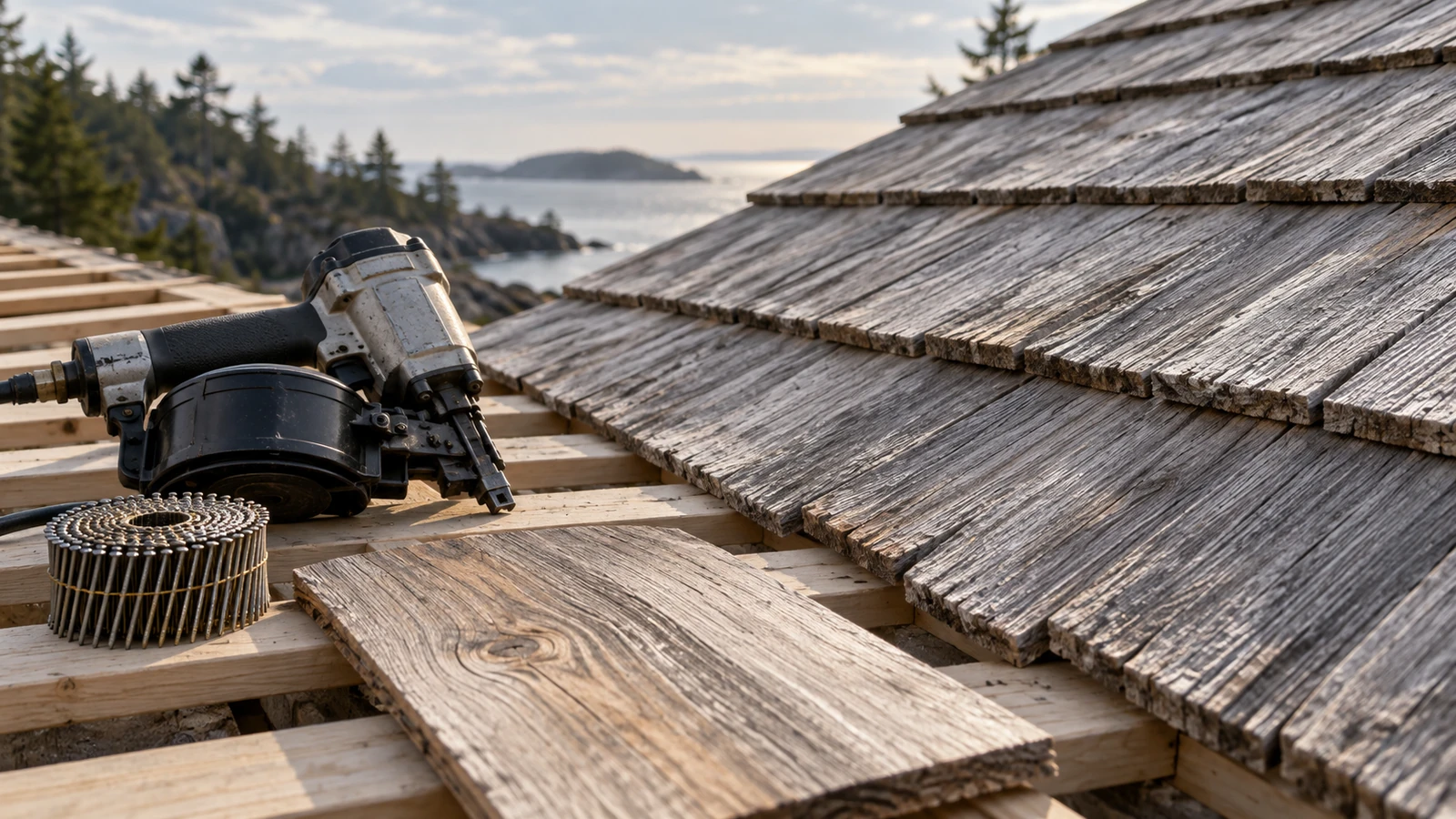

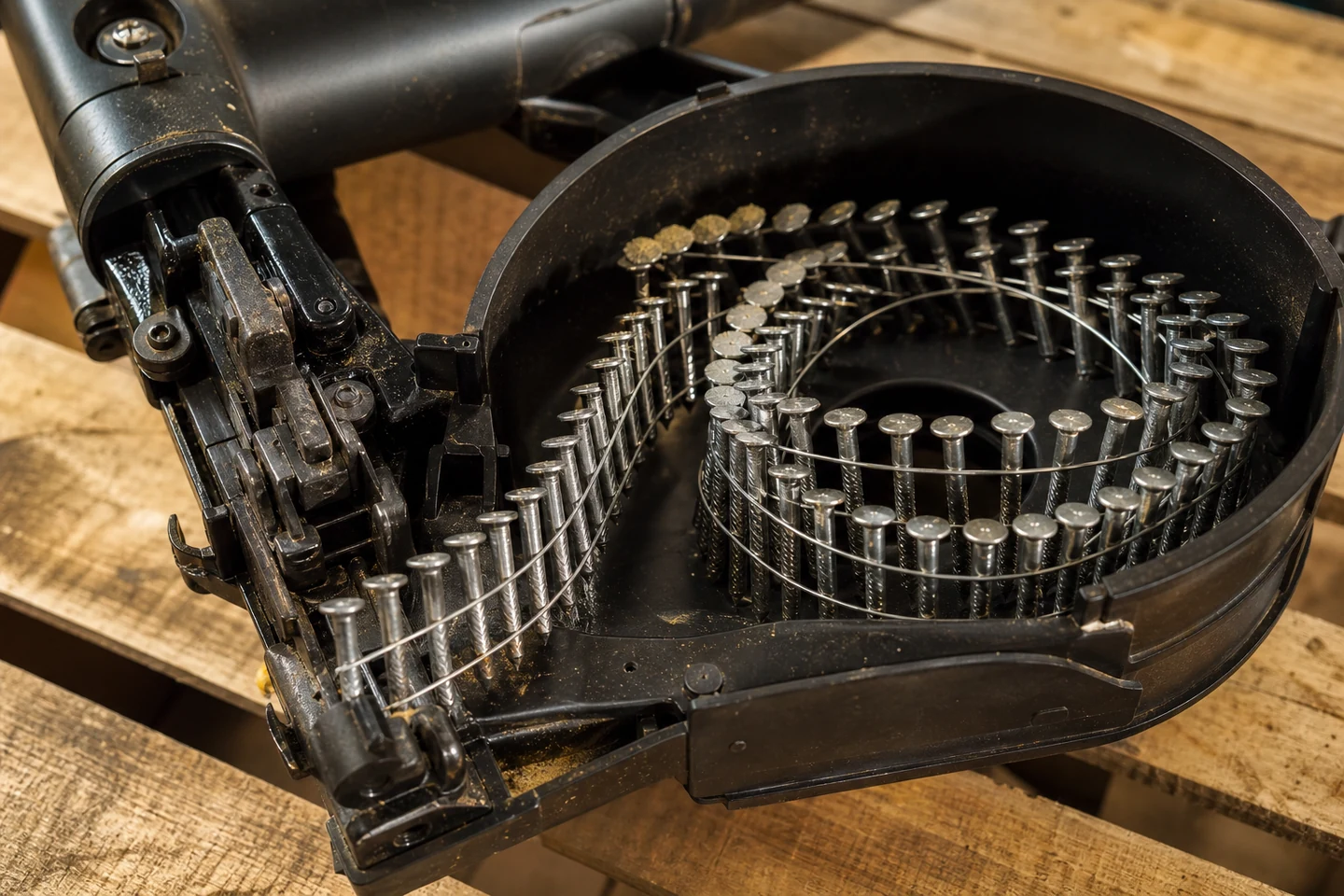
When coil nails unwind in magazine, preserve the expanded shape before compressing the coil or closing the canister again. A coil can spring outward because of its wound condition, carrier or weld behavior, incorrect canister support, damaged packaging, rough loading, feed-gate resistance, or a size mismatch. The direction and location of expansion help separate those paths.
Disconnect the tool according to its instructions. Mark the leading nail, outer tail, coil rotation, support setting, and point where the coil first left its expected track.
Draw the coil as three reference circles
Record the inner opening, working body, and outer tail rather than describing the coil as simply loose. Photograph from directly above with a scale and from the feed-gate side. Note whether the expansion is uniform, concentrated at the leading segment, or limited to the outer wraps.
A uniformly larger coil suggests a different condition from one kinked near the feed gate. Do not force the coil into a circular shape before documenting these differences.
Check the canister support against the nail length
Confirm the support plate or height adjustment specified for the loaded nail length. Inspect whether the coil sits level, whether the points or heads contact the canister, and whether the outer wrap is trapped by the cover. Record any missing insert, incorrect setting, debris, or wear.
A coil that sits too high or low may tilt as it turns. That tilt can allow one wrap to climb over another or pull the leading segment away from the intended feed path.
Follow expansion back to a physical clue
| Coil pattern | Possible direction | Next evidence |
|---|---|---|
| Outer tail springs outward | Packaging restraint or wound set | Unopened coils and carton condition |
| Leading segment bows at gate | Feed drag or loading route | Gate alignment and first nail position |
| One wrap climbs another | Support height, tilt, local deformation | Canister level and coil flatness |
| Spacing opens at selected welds | Carrier damage or handling | Weld sequence and package impact |
Inspect the coil without cutting the carrier
Keep the original wrap order. Check nail spacing, head overlap, point orientation, wire welds, nail straightness, carrier tension, and visible distortion. Compare the affected region with the opposite side of the same coil and with a retained unopened coil from the package.
Cutting wire or separating nails may relieve stored shape and hide whether the expansion came from the coil or from the canister path. Use destructive examination only after the intact condition is recorded.
Repeat the loading sequence under control
After qualified tool inspection, load a confirmed compatible coil using the documented support setting and route. Keep tool, operator, nail length, coil type, and opening method fixed. Observe whether the coil remains level while the cover closes and during a short controlled feed test.
Then compare a suspect coil only if permitted. Stop if wraps overlap, the leading segment binds, welds separate, or the cover applies abnormal pressure. Do not use repeated firing to pull a visibly distorted coil into place.
Control packaging and bench handling
Record carton compression, inner wrapping, moisture exposure, loose coils, drop events, and how opened coils are stored. A production trial should include coils from different carton positions because top, corner, and center packages may experience different restraint or impact.
The limitation is scope: coil shape inspection does not establish tool safety, nail-lot conformity, joint performance, or compatibility for every production condition. Those conclusions require the relevant tool, product, service, and sampling criteria.
Review the Coil Nail category and the broader pneumatic fastener range. Send nail dimensions, collation type, canister setting, package photographs, coil measurements, and feed position through the inquiry page when coil nails unwind in magazine.
FAQ
Can I squeeze an expanded coil back into the canister?
Do not force it. Compression can overlap wraps, damage welds, and change nail presentation. Follow the tool and quality procedure after documenting the shape.
Does a loose coil always mean weak wire welds?
No. Wound set, packaging, support height, loading route, canister contact, and feed resistance can also produce visible expansion.
Should opened coil nails be stored without restraint?
Use the supplier and workplace storage method. Retaining identification and protecting the original coil geometry helps prevent damage and supports traceability.
Three measured coil circles make coil nails unwind in magazine a geometry problem that can be compared across tools, packages, and loading methods.