
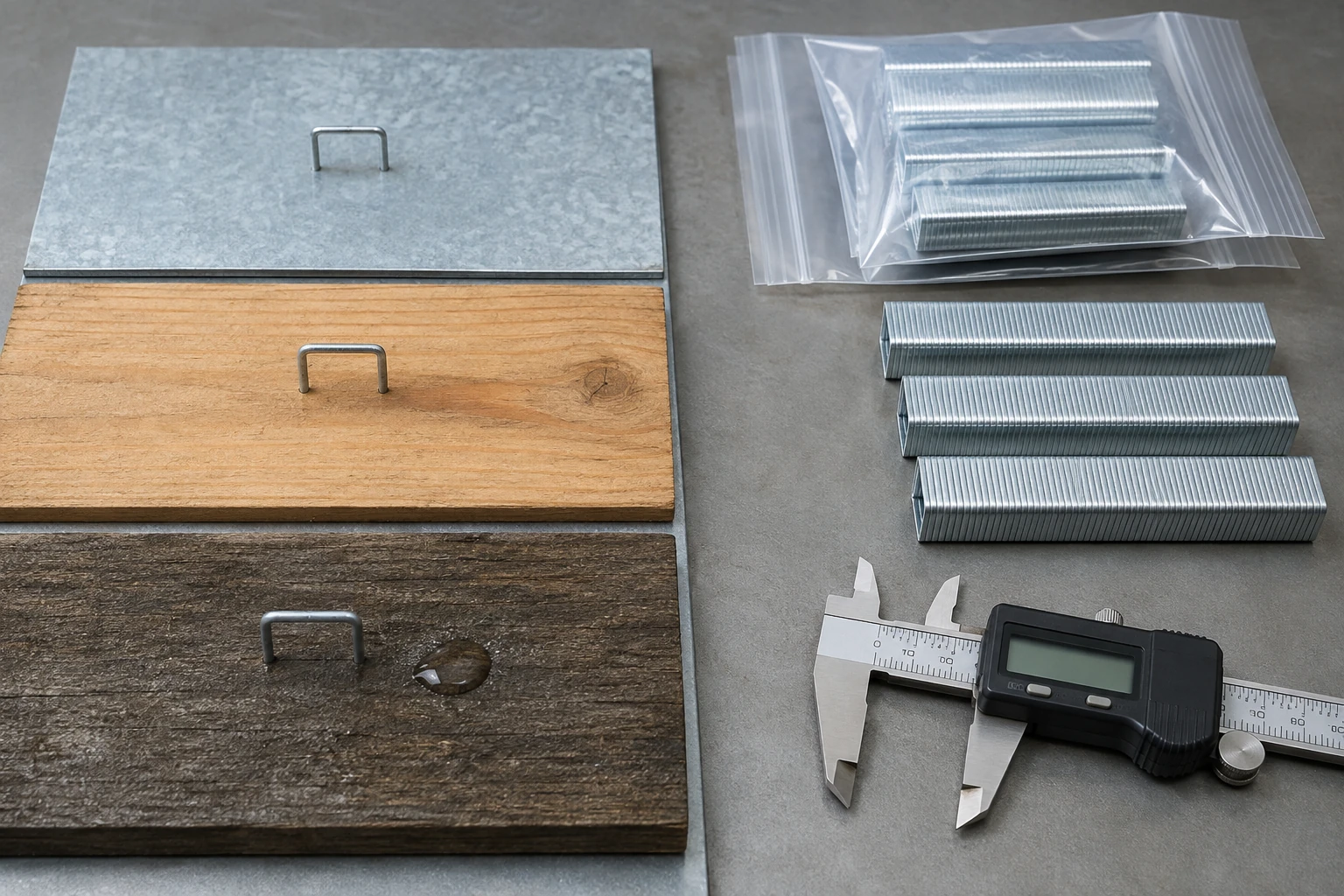
A galvanized staples supplier should be evaluated against the environment where the staple will be driven, not only against the shine of a zinc-coated strip. Indoor dry storage, condensation, treated wood, cleaning chemicals, and salt-bearing air can create different review paths. The coating is one control; the application envelope is the decision.
ProAirNails uses a simple sequence: describe the climate, identify the substrate, expose representative samples, inspect the finished surface, and define what must be checked at receiving. This gives purchasing and quality teams a common record when the same staple may be used in several locations.
Draw the exposure tree in five minutes
Start with moisture contact. Ask whether the staple stays dry, sees intermittent condensation, touches wet material, sits under direct weather, or faces salt or chemical contamination. Then record drying time, cleaning method, trapped water, and access for replacement. A sheltered outdoor panel and a coastal crate are not the same exposure simply because both are called “exterior.”
What galvanized staples can and cannot answer
Galvanizing can be relevant when the buyer needs a zinc-based surface on a specified staple. It does not automatically establish a service-life period or guarantee that a finished panel will remain stain-free. Point damage, cut edges, storage humidity, substrate chemistry, and contact with dissimilar metals still need attention. Make the claim no wider than the evidence.
What a galvanized staples supplier should document
A galvanized staples supplier should connect the coating description to the wire, point, package, exposure panel, and receiving check. That chain makes a later reorder comparable to the sample instead of comparable only by name.
Ask the supplier for a coating description
| RFQ line | Request | Reason |
|---|---|---|
| Base wire | Wire designation and dimensional range | Separates the coating from the staple body |
| Surface | Declared galvanizing route or coating description | Clarifies what “galvanized” means in the offer |
| Geometry | Crown, leg, point, strip angle, count | Connects surface choice to tool fit |
| Application | Substrate, exposure, finish, cleaning conditions | Defines the environment being purchased for |
| Evidence | Sample, lot label, test report, and limitations | Allows a controlled approval and reorder |
Build a three-panel finish review
Prepare one dry control, one moisture-conditioned panel, and one panel using the actual finish or treated substrate. Drive the staples with the named tool and retain both the strip and the coupon. Inspect before exposure, after exposure, and after the planned cleaning or curing step. Look for red rust, white corrosion products, staining, coating transfer, proud crowns, splitting, and pull-through at the surface.
- Photograph the strip as received before wiping it.
- Use the same lighting for before-and-after finish images.
- Mark staple positions so a stain can be traced to a lot.
- Keep exposed and unexposed controls together.
- Write an acceptance rule before looking at the result.
Do not turn salt spray hours into a calendar promise
The official ISO 9227:2022 page describes salt spray methods for assessing corrosion behavior in artificial atmospheres. It does not provide a universal conversion from chamber hours to outdoor service life, and it does not select a coating for a particular staple application. Report the method, specimen, preparation, and acceptance rule exactly.
Check the fastener standard and the actual tool together
The ASTM F1667/F1667M-21a page covers driven fasteners, including stated requirements for materials, dimensions, coatings, and finishes. Its scope does not approve a buyer's moisture exposure, wood treatment, finish system, magazine, or service-life claim. Load the proposed strip into the exact tool before accepting a surface result.
Use a receiving check that can catch the wrong carton
At receiving, verify item code, crown and leg dimensions, strip angle, count, carton condition, and lot identity. Inspect a small sample for loose staples, damaged points, rubbed surfaces, and mixed cartons. Keep the check proportional to the risk; it is not a replacement for the original approval panel. A clear record is especially useful when two galvanized finishes look similar in storage.
Choose the right branch when a panel changes color
| Observation | Possible branch | Next step |
|---|---|---|
| Rust only at a cut or damaged point | Local coating damage or handling | Review point, storage, and drive contact |
| Stain follows the filled crown | Metal, moisture, or finish interaction | Repeat with an unfinished control and actual filler |
| Samples arrive with rubbed strips | Packaging or transit exposure | Map carton position and request packing evidence |
| Tool leaves proud crowns | Geometry or setup mismatch | Correct series, driver, or pressure before corrosion claims |
| Only treated wood changes | Substrate chemistry branch | Identify treatment and limit approval to that material |
Send an exposure-ready inquiry to ProAirNails
Describe the environment, substrate, finish, tool model, staple series, dimensions, exposure duration, cleaning or curing cycle, sample quantity, annual volume, packaging route, and acceptance rule. ProAirNails can discuss staples, related pneumatic fasteners, the product range, and samples through the inquiry page.
State the boundary in the purchase record
Galvanized staples supplier approval should name the tested coating description, staple geometry, tool, substrate, exposure, and inspection rule. It does not prove every climate, chemical, finish, carton, or future production lot. ProAirNails can organize declared product evidence; the buyer controls application release, maintenance, and environmental risk decisions.
FAQ
Does galvanized always mean outdoor-ready?
No. Outdoor exposure varies, and coating choice must be tied to moisture, chemicals, substrate, finish, and service conditions.
What should be included in a coating request?
Ask for the wire, declared coating description, geometry, application environment, samples, lot identity, and limitations.
Can salt spray hours predict years outside?
No. Artificial chamber results are comparative evidence under a stated method, not a universal outdoor-life conversion.
Why test the finished panel?
Filler, paint, treated wood, moisture, and cleaning can change what a bare metal test suggests.
Should samples be wiped before inspection?
Photograph and document the as-received condition first; wiping can remove useful evidence of transit or storage.
What receiving details matter most?
Verify item code, dimensions, strip angle, count, carton condition, lot identity, and visible surface damage.
Can the same staple serve dry and damp zones?
Only after the buyer has evaluated both environments and declared the approved envelope.
What causes a dark mark around a crown?
Possible causes include metal, moisture, filler, finish, heat, or surface contamination; isolate them with controls.
When should a panel be repeated?
Repeat after changes to coating, wire, geometry, tool, substrate, finish, exposure, package, or acceptance rule.
How should a galvanized staples supplier document a coating?
Link the declared surface, staple geometry, sample lot, exposure panel, package identity, and acceptance rule in one record.