
One nails and staples manufacturer can simplify a mixed fastener program, but concentration is only valuable when the source can control every approved SKU and the buyer has a credible continuity plan. Several specialized suppliers may provide deeper product focus, while adding interfaces, shipments, documents, and accountability gaps.
ProAirNails recommends choosing the sourcing architecture after mapping the portfolio, not before. The decision should reflect tool systems, application risk, order volume, mixed-load economics, quality evidence, and the cost of interruption.
Map the portfolio into control families
| Family | Examples | Control question |
|---|---|---|
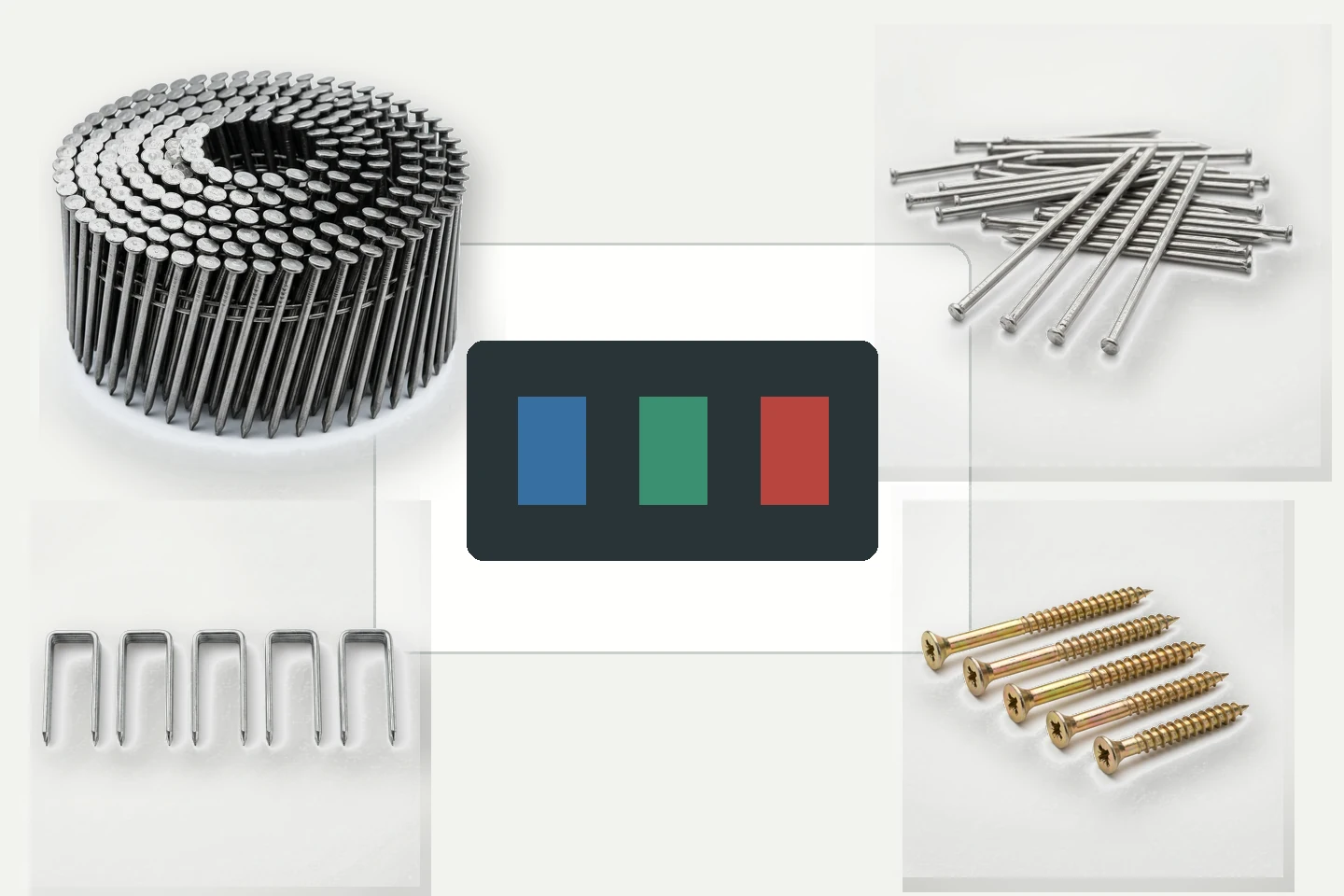
| Finish nails and pins | Brad nails, fine pins, headless pins | Can the source control tool fit, strip condition, length, and visible mark? |
| Coil and collated nails | Wire or plastic collated coils | Can it control collation, feed geometry, coil count, and pallet-line performance? |
| Pneumatic staples | Furniture, upholstery, packaging, industrial series | Can it map crown, wire, leg, series, and compatible tools? |
| Screws | Drywall and chipboard families | Are screw processes, standards, tests, and packing separately controlled? |
A broad catalog is not proof of equal process depth. Ask which products are made, controlled, or sourced through each site and route, and how the quotation identifies that difference.
What one-source purchasing can improve
A single commercial interface can simplify forecasts, artwork, mixed-SKU planning, documentation, complaint ownership, container consolidation, and payment administration. It may also make low-volume accessory SKUs practical when combined with larger core products.
The benefit depends on accurate product ownership. If the supplier cannot trace or technically support one family, consolidation may hide rather than remove complexity.
Where one-source concentration becomes risky
- One site, process, port, material route, or approval controls too much volume
- A disruption stops several fastener families at once
- Low-volume SKUs receive weak process attention
- Commercial convenience replaces product-specific testing
- Buyers lose current drawings, samples, or alternative-source knowledge
- Mixed orders become hard to expedite when one SKU delays the whole load
Concentration risk is not an argument against one source. It is a reason to define recovery time, inventory, alternate routes, controlled specifications, and transfer-ready samples.
What several suppliers can improve
Specialists may offer stronger process knowledge, more focused tooling, or better scale in one family. Multiple sources can reduce dependence and allow regional or lead-time options. They can also provide useful competitive evidence when specifications are truly comparable.
The cost is governance: more audits, artwork revisions, payments, minimum quantities, containers, documents, samples, and complaint interfaces. The buyer must prevent two “equivalent” products from drifting into different specifications.
Compare architectures with one scorecard
| Decision factor | One-source question | Multi-source question |
|---|---|---|
| Technical depth | Is every family supported by product evidence? | Can specifications remain aligned across specialists? |
| Continuity | What stops all families together? | Can another source absorb volume without reapproval delay? |
| Mixed-load economics | Do consolidated loads reduce landed cost? | Do split shipments erase unit-price savings? |
| Quality ownership | Is one party clearly accountable? | Can failures be isolated to the correct source and lot? |
| Change control | Does one process govern all SKU changes? | Can several systems issue consistent notices? |
Weight the factors by the buyer's actual exposure. A distributor with many low-volume SKUs may value consolidation differently from a factory whose one coil-nail SKU can stop a pallet line.
Design the mixed-order rules
If one nails and staples manufacturer supports the range, define minimums by SKU and family, sample and artwork rules, mixed-carton restrictions, pallet separation, container sequence, partial-shipment decisions, and which delayed item may hold the load.
Use clear family and SKU labels. Similar cartons should not depend on tiny printed differences. Require a load plan that makes receiving inspection and warehouse placement practical.
Keep standards product-specific
A mixed portfolio may cross different standards and application rules. The ASTM F1667 standard page covers a driven-fastener framework when applicable, while the ASTM C1002 page addresses a defined gypsum-panel screw scope. One certificate or standard reference should not be stretched across unrelated families.
Choose a sourcing architecture, not a permanent slogan
A practical plan may use one primary supplier for consolidation, approved alternatives for critical families, and periodic market checks for specialized products. Define what evidence an alternate source needs before it becomes operational.
Review the architecture after material changes, major complaints, new tools, volume shifts, freight disruption, or new destination requirements. A good plan can change without losing control.
The limitation is important: selecting one nails and staples manufacturer does not prove every SKU has equal process depth, while using several suppliers does not automatically create resilience. Both models require product-specific evidence, transfer-ready specifications, and a tested continuity plan.
Discuss the portfolio with ProAirNails
Browse the ProAirNails pneumatic nails range, coil nails, brad nails, and air staple pins. Send the SKU matrix, tool coverage, annual demand, mixed-load plan, destination, continuity priorities, and sample requirements through the ProAirNails inquiry page.
The right nails and staples manufacturer strategy is the one that keeps every SKU technically controlled while making supply recoverable.
FAQ
Is one manufacturer always cheaper?
No. Consolidation may reduce freight and administration, but SKU minimums, delays, specialization, quality risk, and concentration can change total cost.
What products belong in one sourcing family?
Group products by manufacturing and control needs, tool system, application risk, specification, testing, packaging, and disruption exposure rather than catalog headings alone.
Should every critical SKU have two sources?
Not automatically. Compare interruption cost, qualification effort, inventory, transfer time, source capacity, and how quickly an alternate can become operational.
How do mixed orders reduce cost?
They may combine low-volume SKUs, improve container use, simplify documents, and reduce shipment count, provided delays and handling do not offset the benefit.
What is the main risk of several suppliers?
Specifications, samples, labels, documents, and change notices can drift unless the buyer maintains one controlled requirement for each SKU.
What is the main risk of one supplier?
A shared disruption or weak product family can affect a large part of the portfolio, and commercial convenience may hide technical gaps.
How should complaints be handled in a mixed portfolio?
Trace the exact SKU, source, lot, shipment, tool, material, failure pattern, and retained sample before applying a conclusion to the whole range.
Can one audit cover all products?
A system audit may cover shared controls, but product-specific processes, specifications, samples, tests, packing, and risks still need review.
When should the sourcing plan be reviewed?
Review after significant changes, new products or tools, repeated failures, freight disruption, volume shifts, or changing destination requirements.
What should I send ProAirNails for a mixed-range RFQ?
Send the SKU matrix, product specifications, tool models, quantities, destination, packing, artwork, documents, mixed-load rules, and sample approval plan.