
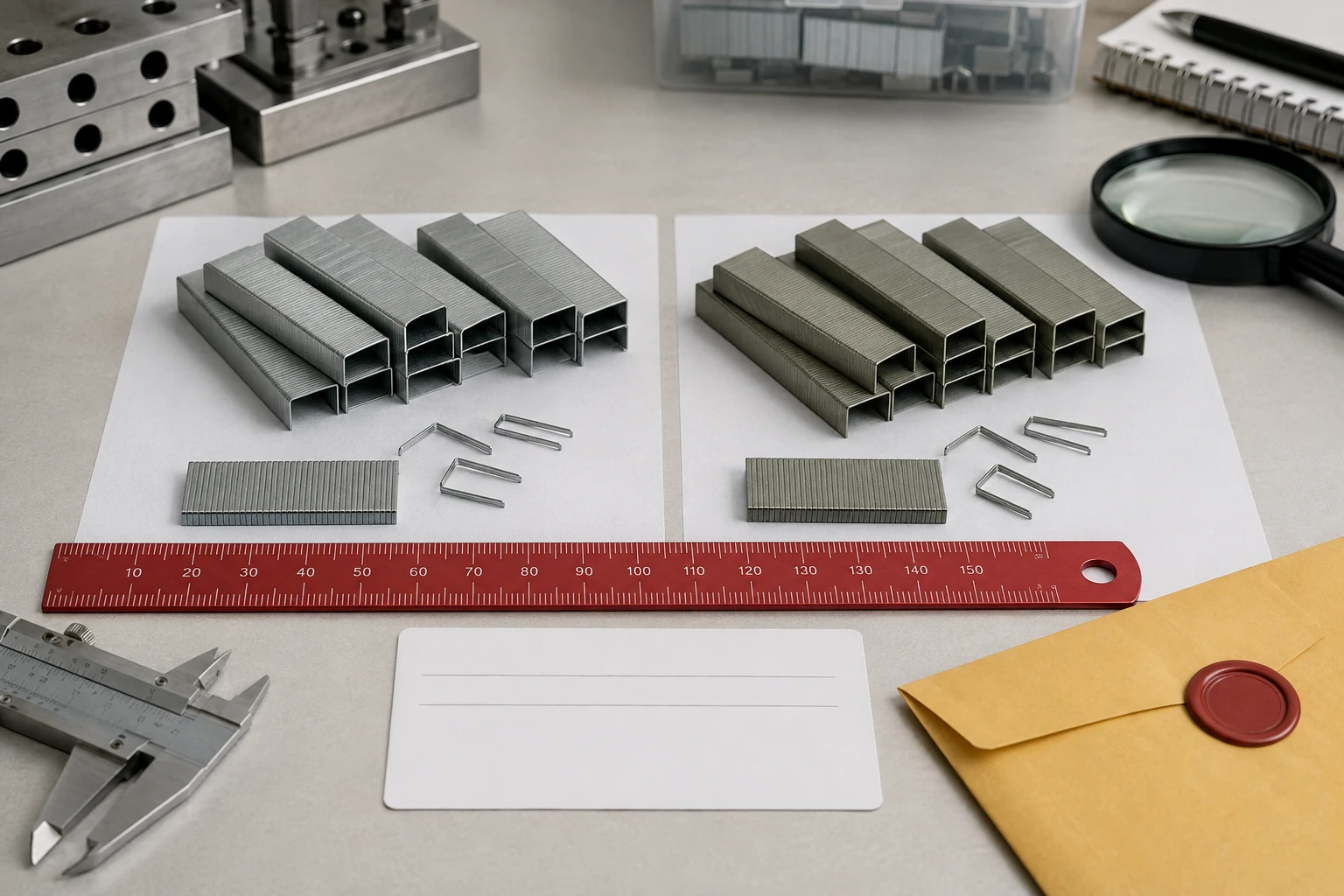
An OEM staples manufacturer is part of a change-control chain, not just a source of private-label cartons. The critical handoff is the identity of the approved staple: dimensions, wire, point, coating, collation, package, tool, application, and artwork or label. If one of those moves without a visible revision, the buyer may be approving a different product without realizing it.
ProAirNails recommends freezing a reference sample before scaling. Give the sample a revision code, record what was tested, and define which changes require a new approval. This makes an OEM project easier to manage when purchasing, packaging, production, and quality teams are working on different calendars.
Begin with the product identity card
Put one concise identity card inside the project file. Include the staple series, crown, leg, wire, point, surface, collation, count, carton, inner pack, tool, material stack, finish, market, and acceptance rule. Add a photograph and a retained physical sample. The card is not a substitute for a drawing; it is the index that keeps the drawing, sample, and carton connected.
Define what OEM may change and what it may not
Some changes are commercial, such as a carton color or label language. Others can change installation or appearance, such as wire, leg length, point, crown, adhesive, coating, strip angle, or count. Put the boundary in writing. A request to “match the sample” is incomplete if the sample has no revision, lot, or measurement record.
What an OEM staples manufacturer must freeze
An OEM staples manufacturer must freeze the physical staple identity before the carton becomes the visible product. Record the revision, sample, tool trial, finish result, package, and release owner together.
Use a revision ledger instead of email memory
| Ledger field | Example entry | Decision use |
|---|---|---|
| Revision | Unique code tied to drawing and sample | Prevents two versions sharing a name |
| Physical identity | Wire, dimensions, point, surface, collation | Defines the fastener being approved |
| Application | Tool, substrate, finish, market, package | Defines where the approval applies |
| Evidence | Trial log, coupon photos, measurements, reports | Shows why the revision passed |
| Change route | Notify, sample, test, approve, release | Sets the response to a proposed change |
Sign the sample before discussing the carton
Use a small approval set that includes unopened strips, driven coupons, and the proposed inner and outer pack. Sign or otherwise identify the approved physical sample in the project record. The signature does not claim that every future lot is perfect; it says which reference the next lot must be compared with.
- Photograph the sample beside a scale or declared reference.
- Record the supplier lot and package position.
- Keep one sample sealed and one available for testing.
- Link artwork or label files to the same revision.
- List the changes that trigger a new sample.
Run the production-tool trial as an OEM gate
Use the customer or named production tool, not a convenient substitute. Record loading, first shot, steady feed, pause and restart, final strip, seating, surface marks, and operator interventions. Then inspect the intended application stack and finish. An OEM carton can look correct while a changed adhesive or strip angle creates a feed issue that only appears on the line.
Keep acceptance sampling in context
The official ISO 3269:2019 page addresses acceptance inspection for fasteners under its stated scope. It does not create the buyer's complete OEM specification, define the application trial, or remove the need to identify the product revision. Use any sampling approach with the lot, characteristic, acceptance number, and decision rule written down.
Use the driven-fastener standard as a second check
The official ASTM F1667/F1667M-21a page provides driven-fastener context within its stated scope. It does not replace the OEM drawing, approved sample, tool trial, or change disposition.
Do not let packaging hide a product change
At pilot and production receipt, compare carton code, inner bag, count, label, strip appearance, and sample identity. Open enough packaging to see whether the physical product matches the approved sample. If artwork changes, keep the fastener and packaging records linked. If the fastener changes, stop the release route until the change has an owner and a disposition.
Handle a proposed change in five moves
| Move | Question | Output |
|---|---|---|
| 1. Describe | What exact field is changing? | Change request with old and new values |
| 2. Screen | Could tool, joint, finish, package, or label be affected? | Impact note and owners |
| 3. Sample | What physical evidence is needed? | New sample and revision mark |
| 4. Trial | Which tool and material stack must be run? | Event log, coupons, photos |
| 5. Release | Who approves and when does the new lot start? | Signed disposition and effective date |
Send ProAirNails the OEM project packet
Provide the reference sample, drawing, revision history, staple dimensions, tool and magazine, material stack, finish, package count, carton artwork, target market, annual volume, sample plan, and change-notification rule. ProAirNails can discuss staples, related pneumatic fasteners, the product range, and samples through the inquiry page.
Limit the OEM promise to the controlled revision
OEM staples manufacturer approval does not cover an unnamed substitute, a changed tool, a new finish, a different carton route, or an unreviewed market. ProAirNails can support a documented sample and change path; the buyer controls brand release, application validation, regulatory review where applicable, and final production authorization.
FAQ
What makes an OEM staple specification complete?
It links dimensions, wire, point, surface, collation, package, tool, application, market, evidence, and revision identity.
Why keep a physical retained sample?
It gives later receiving and change reviews a tangible reference instead of relying on names or photographs alone.
Can artwork changes be released without a fastener trial?
Only when the change is genuinely limited to artwork and the buyer's change process confirms no physical impact.
What should trigger a new sample?
Any change that could affect feed, seating, joint, finish, package identity, or declared acceptance should be screened and documented.
How should pilot lots be labeled?
Use the revision, lot, package position, sample status, and disposition so pilot material cannot be mistaken for released stock.
Does ISO 3269 define the whole OEM program?
No. It provides acceptance-inspection context within its scope; the buyer still defines identity, application, and change control.
Why test the customer's production tool?
Magazine, driver, pressure, handling, and line rhythm can expose effects that a bench tool will miss.
What belongs in a change request?
Old value, new value, reason, affected documents, risk screen, sample need, trial plan, owner, and release timing.
Can a supplier substitute an equivalent staple?
Not silently. Equivalence requires a named comparison and the buyer's documented disposition.
What must an OEM staples manufacturer freeze before scale-up?
Freeze the physical staple identity, revision, tool and application evidence, package identity, and the change-release owner.