
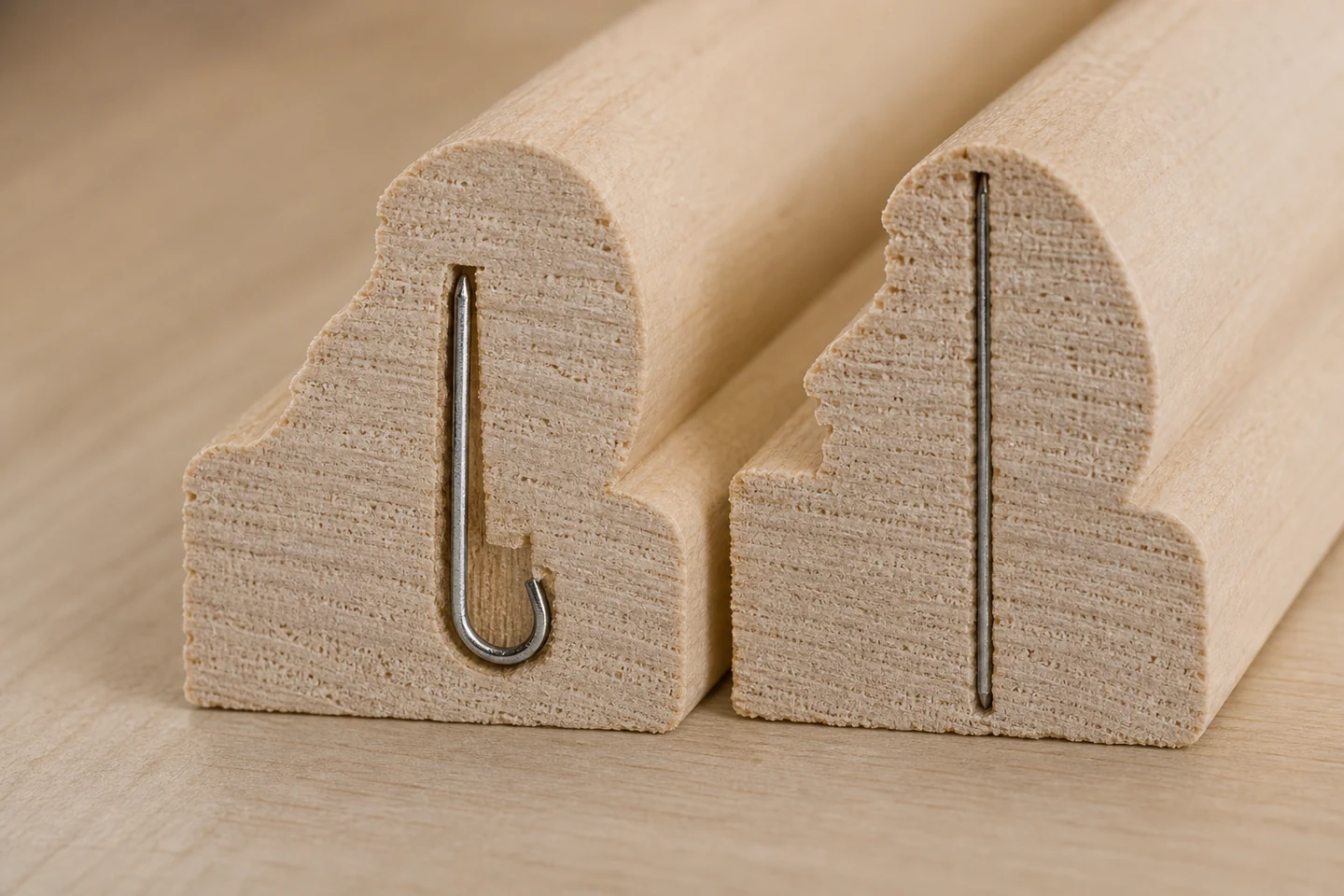
When pin nails curl inside wood, the surface may show only a tiny entry mark while the hidden shank turns sideways or back toward the face. The curl can follow sloping grain, a dense feature, an angled start, unsupported fit-up, damaged pin geometry, unsuitable length, or a combination that lets the slender pin lose its intended path.
ProAirNails recommends preserving the workpiece before pulling the pin. Mark entry direction, grain, joint interface, tool orientation, support, and any nearby exit mark or raised fiber.
Predict the path before cutting the sample
Inspect all faces under side light. Look for a small bulge, split, discoloration, side exit, joint opening, or unexplained resistance during driving. Draw the suspected path on removable tape and select a section plane that is likely to preserve the curve.
Do not pull the pin straight through the entry hole. Extraction can stretch the curve, tear fibers, and make a smooth deflection look like random damage.
Classify the curl shape
| Hidden shape | Possible direction | Next control |
|---|---|---|
| Gradual arc following grain | Grain runout or density boundary | Rotate representative trim |
| Tight hook near the point | Hard feature or unstable long path | Clear-grain sample and length check |
| Bend begins at entry | Tool angle, damaged pin, surface movement | Square contact on full support |
| Turn at joint interface | Gap or mixed material resistance | Dry-fit and clamp comparison |
Photograph the section with a scale and keep a straight control pin from the same joint. One dramatic curl does not define the rate across a package or application.
Check fit-up before blaming the pin
Dry-fit representative parts and record the force needed to close the joint. Bowed molding, a tight profile, uneven backing, adhesive buildup, or unsupported edges can move as the pin crosses the interface. That motion changes the entry angle after the tool has already fired.
Inspect unused strips for pin straightness, spacing, adhesive condition, mixed length, and packaging damage. Confirm tool and pin compatibility and retain package identification.
Compare path stability one variable at a time
Use actual trim and backing offcuts. Keep tool, pressure, operator, spacing, edge distance, support, and material orientation fixed. Compare only an approved variable such as pin length or entry direction, then section both accepted and rejected results.
ProAirNails can use labeled path photographs, pin series, tool model, wood species, profile dimensions, and joint stack to discuss compatible product options. The final application decision still belongs to the user's design, tool, and performance requirements.
Set a repair and containment rule
Define what requires component replacement, alternative fastening, surface repair, or additional inspection. A hidden curled pin may conflict with appearance, joint engagement, edge breakout, or concealed services. Do not add pins around an unknown path without a location plan.
Keep a small path library from representative accepted and rejected sections. Label each sample with pin length, material orientation, profile thickness, entry direction, support, and result. Over time, the library can help a workshop recognize whether a new event resembles grain following, interface movement, entry-angle error, or damaged fastener geometry.
Inspect adjacent finished parts when the same tool and material combination was used before the curl was discovered. The review should be proportionate to the evidence and quality plan, but it should not assume that an invisible surface means a straight internal path.
The limitation is clear: a cut section does not establish structural capacity, full pin-lot conformity, tool safety, or durability for every wood and load. Use the applicable test and acceptance criteria.
Explore the ProAirNails Pin Nails category and wider pneumatic fastener range. Send pin reference, tool model, material stack, entry map, fit-up condition, and section photographs through the ProAirNails inquiry page when pin nails curl inside wood.
FAQ
Can a curled pin nail still hold trim?
The visible entry cannot answer that. Curling changes engagement and may damage the joint, so evaluate the actual path and required joint performance.
Will a shorter pin always prevent curling?
No. It may reduce path length but can also reduce required receiving engagement. Grain, angle, support, fit-up, and pin condition still matter.
Should I increase pressure when pins curve?
More energy may drive the same redirected path faster. Stay within tool specifications and isolate material, alignment, support, and fastener variables first.
A labeled ProAirNails path comparison turns pin nails curl inside wood into visible evidence that can guide the next controlled test.