
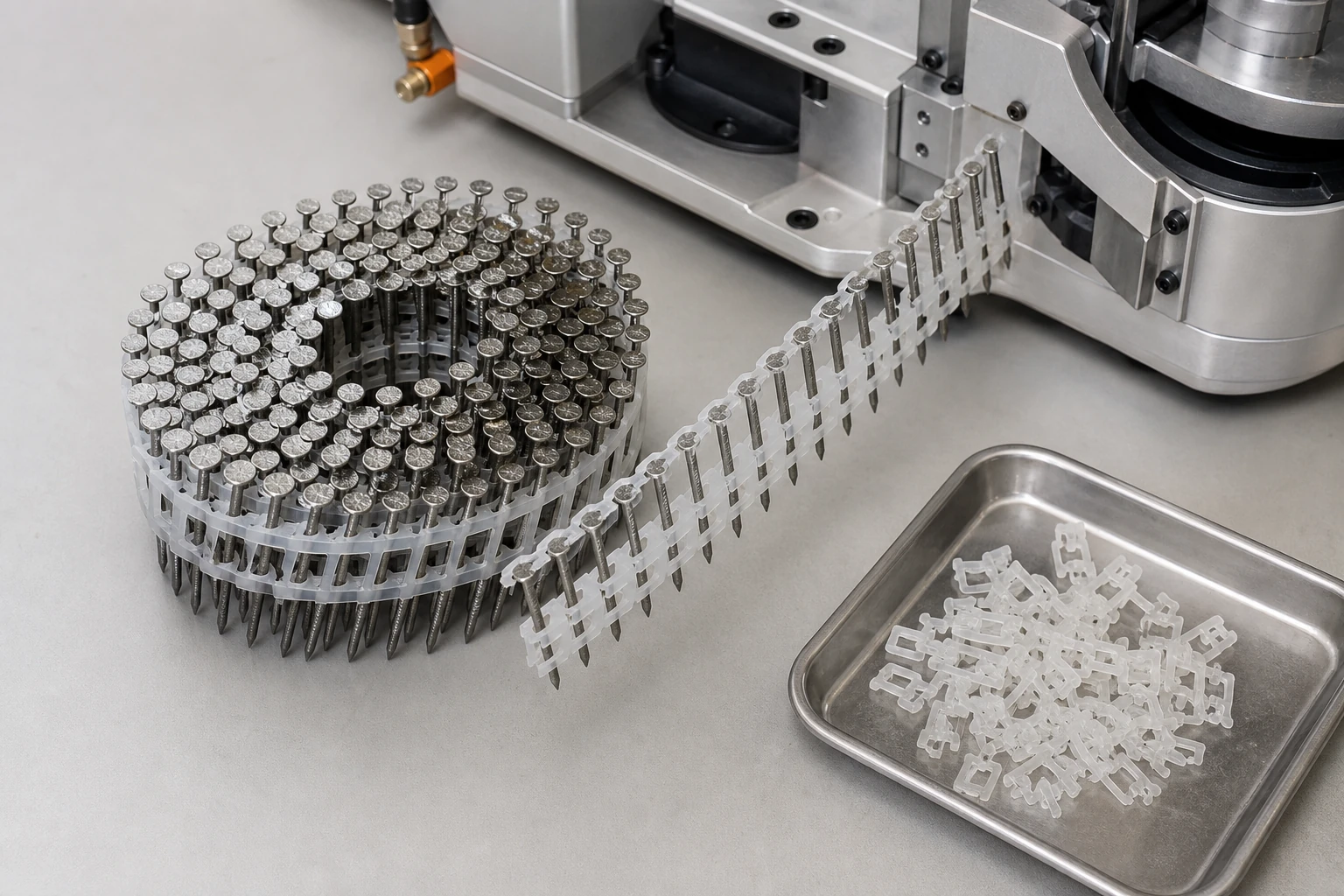
Plastic collated coil nails combine the nail specification with a carrier system that must load, advance, break away, and leave the work area safely in the intended tool. A buyer who checks only nail length and shank style misses the part that controls spacing, coil handling, and the path of every carrier fragment.
ProAirNails recommends following one carrier segment from the closed coil to the magazine, feed mechanism, drive point, fragment exit, work surface, and collection area. That physical trace reveals compatibility questions that a catalog photo cannot answer.
Begin with the carrier’s complete route
Draw the path from carton to discarded fragment. Record how the coil is removed, supported, loaded, indexed, and advanced. Then document where the plastic separates, whether it remains attached to the next nails, and where fragments land. Include operator position and nearby finished surfaces in the review.
What plastic collated coil nails must match
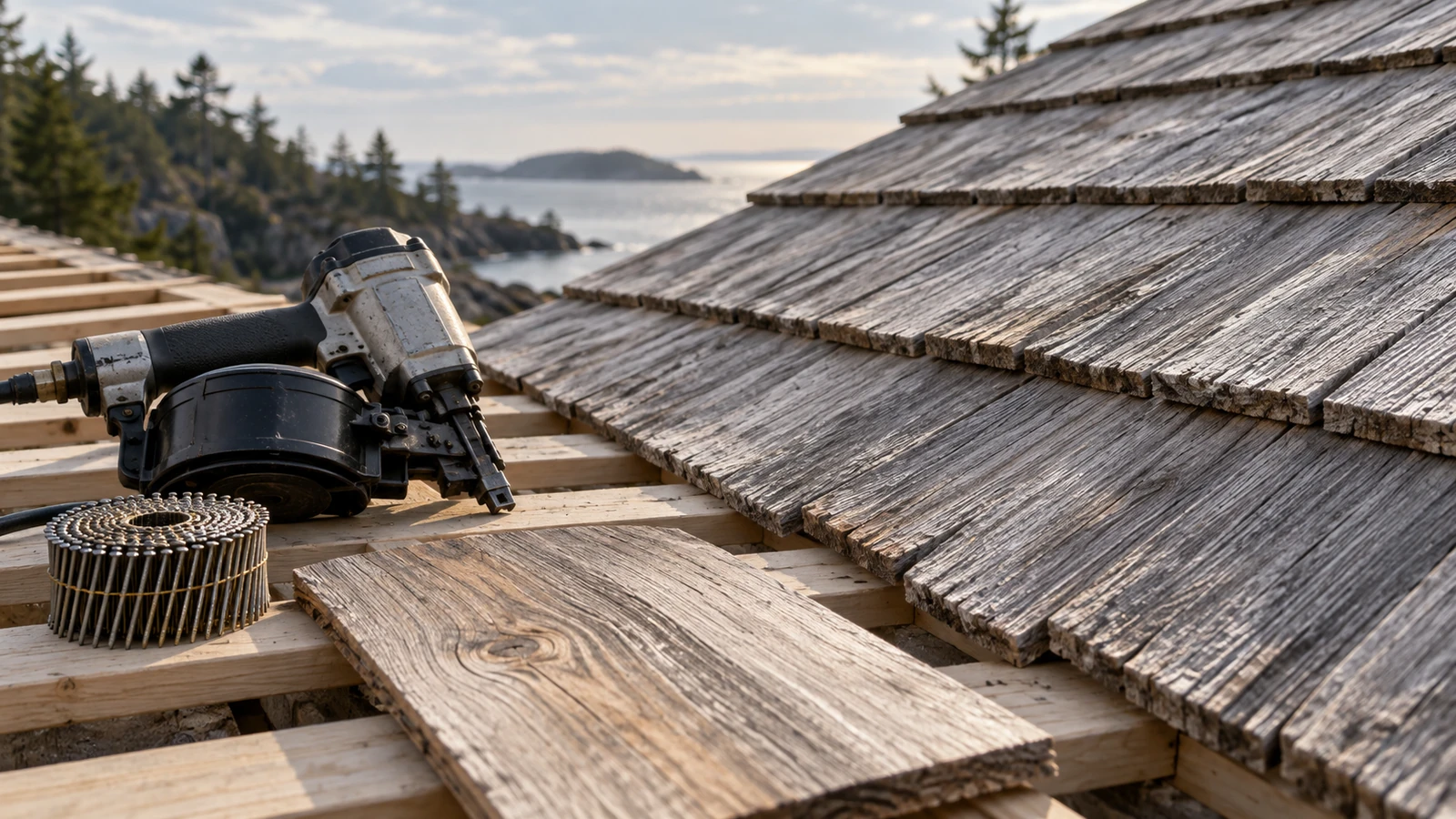
Compatibility includes nail diameter, length, head, shank, point, pitch, coil diameter, collation angle, carrier geometry, and the nailer’s magazine and feed design. “Coil nailer” is not a complete tool designation. Use the manufacturer’s approved fastener range as the starting boundary.
Put carrier details into the RFQ
| Feature | Buyer input or supplier evidence | Failure prevented |
|---|---|---|
| Nail geometry | Diameter, length, head, shank, point | Wrong drive or holding behavior |
| Coil geometry | Angle, pitch, diameter, count, direction | Loading and advance problems |
| Carrier | Material, position, breakaway form | Fragments, marks, or incomplete separation |
| Tool | Brand, model, magazine, condition | Assumed compatibility |
| Application | Substrate, finished face, drive orientation | Unseen surface and safety consequences |
Inspect a coil before it enters the magazine
Check roundness, crossed turns, head alignment, carrier cracks, missing bridges, distorted leaders, loose nails, debris, and carton pressure marks. Measure the coil in its free supported state. Do not reshape it before recording evidence because that can hide packaging or collation damage.
- Code each coil and carton position.
- Photograph leader, middle, and tail.
- Count pre-existing loose fragments.
- Confirm feed direction before loading.
- Keep one as-received coil as a retained control.
Run the trial as a sequence of events
Use the named tool, pressure, substrate, support, and drive orientation. Record loading resistance, first shot, steady run, restart after pause, final turns, skips, doubles, feed interventions, carrier separation, surface marks, and fragments. Stop safely if debris projects unpredictably or the magazine resists.
Capture fragments instead of guessing their destination
Set up a controlled collection area that does not interfere with safe tool operation. Count and photograph fragments, identify large connected pieces, and note their direction. Inspect the workpiece for trapped plastic, impressions, scratches, or material embedded near the nail head. Follow the tool manufacturer’s safety instructions throughout.
Interpret feed and breakaway patterns separately
| Observed pattern | Likely review branch | Next evidence |
|---|---|---|
| Coil loads but carrier does not separate cleanly | Carrier-tool interaction | Slow event review and conforming comparison |
| Fragments clear but nails skip | Pitch, feed, leader, or tool condition | Nail-count event log |
| Plastic marks finished face | Breakaway direction and surface sensitivity | Representative finish coupon |
| Damage concentrates at carton edge | Packaging compression | Carton-position map |
| Events appear only after a pause | Restart and coil-set condition | Timed pause comparison |
Read ASTM F1667’s collation boundary carefully
The active ASTM F1667/F1667M-21a page covers driven fasteners and explicitly notes that cohering materials and relative orientation of collated fasteners are generally outside its scope except as stated in the workmanship section. Therefore, a product-standard reference does not replace the buyer’s carrier and tool trial.
Keep tool safety distinct from product approval
The official ISO 11148-13:2017 page addresses safety requirements for hand-held non-electric fastener driving tools. It does not certify a specific coil and carrier combination in the buyer’s substrate, nor does a compatibility trial replace tool maintenance or operator training.
Include packaging in carrier qualification
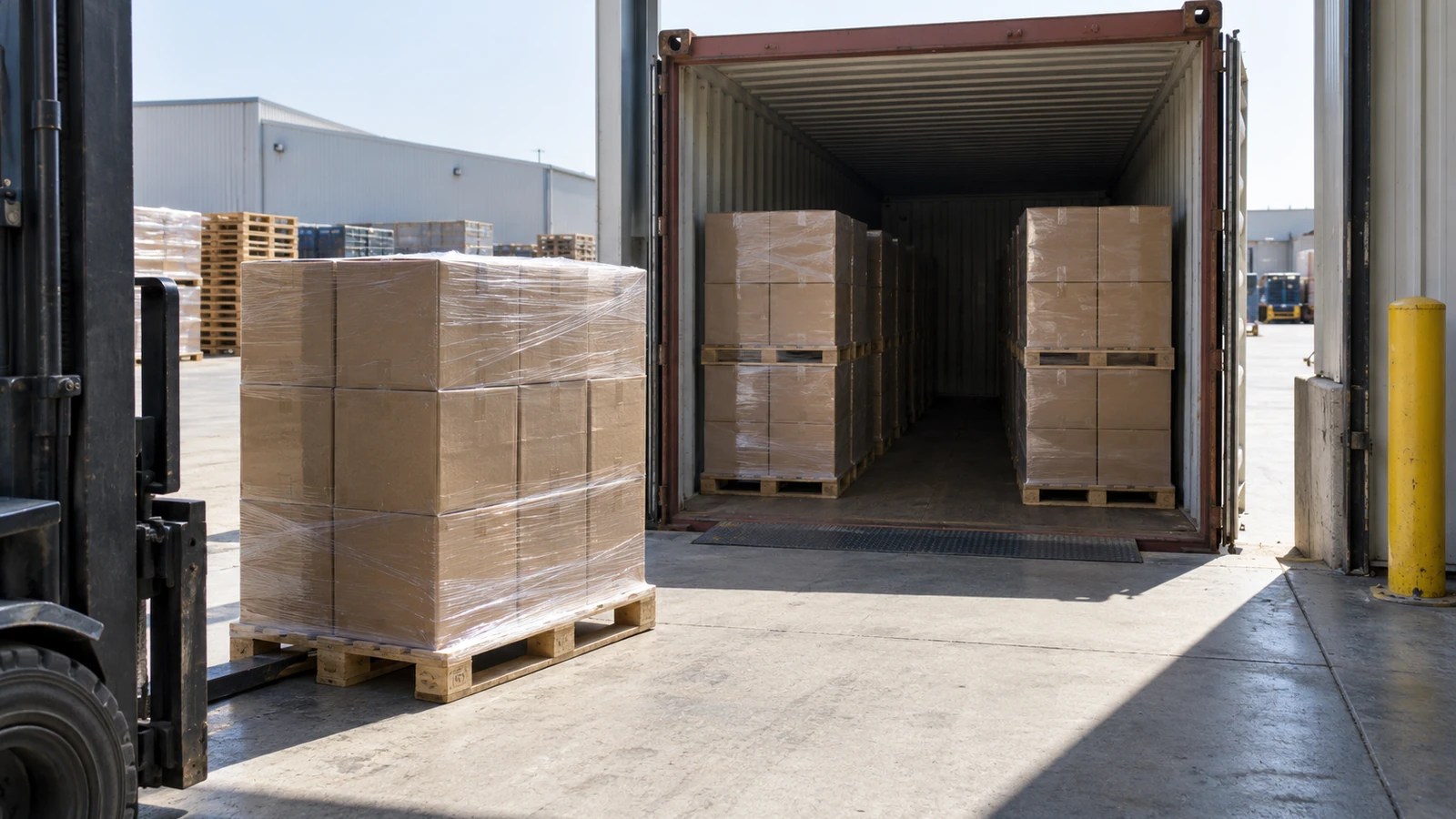
Declare coil count, inner support, carton orientation, moisture protection, stack limit, pallet pattern, and destination route. Plastic collated coil nails can still crack or distort if a suitable carrier is compressed in transport. Recheck leaders and outer turns after a representative package-handling evaluation.
Price the usable feed event
Compare price per thousand nails with interventions, skipped shots, surface cleanup, fragment control, damaged-coil rate, packaging, and tool downtime. The lowest invoice price can lose its advantage if the carrier creates unpredictable handling or the coil cannot maintain a stable production rhythm.
Send ProAirNails a tool-specific inquiry
Provide nail and coil dimensions, carrier form, nailer model, magazine, pressure, substrate, finish sensitivity, drive orientation, event count, fragment requirement, annual quantity, packaging, destination, and acceptance limits. ProAirNails can discuss coil nails, related pneumatic fasteners, the broader product range, and samples through the inquiry page.
Limit the approval for plastic collated coil nails
A short trial cannot prove every coil, nailer, pressure, operator, substrate, package route, or future tool condition. Fragment behavior can change with orientation and material contact. ProAirNails can support identified product evidence, while the buyer controls tool approval, risk assessment, maintenance, guarding, and production release.
Retain the tested coil, fragment sample, event log, and workpiece. Repeat the plastic collated coil nails review after changes to carrier, pitch, coil geometry, packaging, tool, pressure, substrate, orientation, or acceptance rule.
FAQ
Are all plastic-collated coils interchangeable?
No. Nail, coil, carrier, angle, pitch, magazine, and feed requirements must match the named tool.
Why collect carrier fragments?
Collection shows separation completeness, fragment size, direction, cleanup burden, and potential contact with the work.
Can ASTM F1667 alone approve the carrier?
No. Its published scope notes important boundaries around cohering materials and relative orientation.
What should be checked before loading?
Inspect roundness, turns, heads, carrier bridges, leaders, loose nails, debris, and packaging marks.
Why include the first and last coil turns?
Leaders and tail regions can experience different packaging, loading, and feed conditions from the center.
Can carrier pieces mark a finished surface?
Yes. Test the actual finish and drive orientation rather than relying on an unfinished wood trial.
What makes a useful event log?
Record nail count, loading, pause, skip, double, intervention, fragment, surface mark, and recovery.
Should a deformed coil be reshaped for testing?
Document the received condition first; reshaping can erase evidence and create an unrepresentative result.
How should quotations be compared?
Compare price with usable feed rate, interventions, cleanup, damaged coils, packaging, and downtime.
Which changes require requalification?
Review changes to carrier, nail geometry, pitch, coil size, packaging, tool, pressure, substrate, or orientation.