
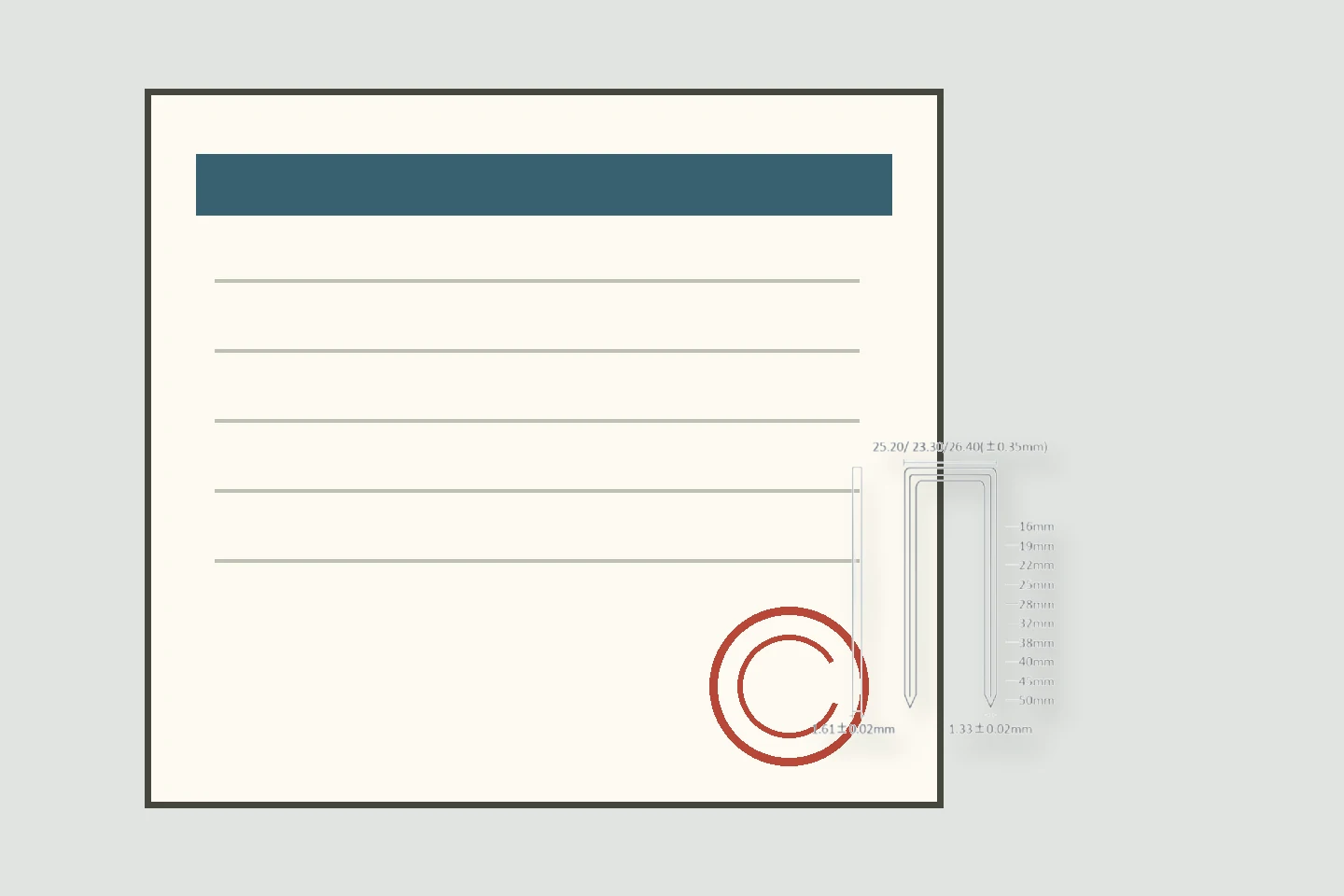
A pneumatic fastener material certificate should identify the material, supplier, lot, and declared result well enough for a buyer to connect the document to the received product. It supports traceability and risk review, but it does not by itself prove collation, dimensions, tool feed, finish appearance, or application performance.
ProAirNails recommends checking the certificate before production release, then matching its identifiers with the wire record, production lot, inspection report, carton label, and retained sample.
Define the certificate's job
Decide whether the buyer needs a supplier declaration, a mill certificate, a test report, a coating record, or a complete material-and-lot pack. These documents have different scope. Write the required format and issuer into the RFQ so a generic PDF cannot silently replace a required record.
Review the identity block first
| Identity field | Buyer question | Hold condition |
|---|---|---|
| Material description | Does it match the approved specification? | Generic or conflicting grade |
| Heat, coil, or lot | Can it be traced to the production order? | Missing or reused identifier |
| Supplier and issuer | Who produced and signed the record? | Unclear source or signature |
| Test method and result | What was tested, how, and against what limit? | No method or acceptance basis |
| Date and revision | Does the timing fit the shipped lot? | Undated or obsolete document |
Separate material evidence from product approval
Wire chemistry or mechanical data can support the raw material decision. Finished fastener dimensions, point, head, coating, collation, count, carton, and tool fit remain separate checks. Put those evidence streams in one release pack but do not merge them into one unsupported claim.
Match the certificate to the lot
Compare heat or coil number, production date, supplier batch, wire diameter, and quantity on the certificate with the internal production record. Then compare the finished fastener lot with the carton and pallet label. If the document covers several lots, request the scope and allocation method before accepting it.
Use a certificate decision table
| Finding | Interpretation | Buyer action |
|---|---|---|
| Complete and lot-linked | Material evidence is usable | Continue product and application checks |
| Complete but broad scope | Document may cover multiple lots | Request allocation or lot confirmation |
| Results without method | Hard to compare or audit | Ask for method and limit |
| Certificate and label disagree | Identity risk is unresolved | Hold affected product |
Ask for change history
Material source, wire mill, coating chemistry, drawing revision, collation carrier, and production line changes can alter the risk profile. Require the supplier to state whether the certificate represents the approved source and whether any change requires a new sample or review.
Connect to quality management
The ISO 9001 quality-management overview can help buyers frame documented information, supplier control, nonconforming output, and corrective action. The ASTM F1667/F1667M reference can support applicable driven-fastener terminology. Use both as references, not as evidence that a particular certificate is accurate.
Check the certificate against the fastener
Sample the finished product from the same lot. Verify gauge or diameter, length, head, point, finish, collation, count, and visible damage. Run a representative tool or application trial when the fastener is critical. A certificate that passes while the coil jams is not a complete release.
- Keep the certificate with the purchase order and lot record.
- Photograph the carton label and retained sample together.
- Record who reviewed the document and when.
- List missing evidence as an assigned action.
- Block substitutions until the scope is approved.
Price documentation as usable risk control
Compare the cost of document review, incoming testing, claims, sorting, and line stoppage with the value of a lot-linked record. Keep pneumatic fastener material certificate decisions tied to accepted product and containment speed, not to the number of pages in a PDF.
Put the requirement in the RFQ
State issuer, lot scope, required fields, test methods, language, file format, timing, and retention period. ProAirNails can discuss pneumatic nails, brad nails, and coil nails through the inquiry page.
State the certificate boundary
A material certificate cannot prove every finished dimension, collation event, tool setting, operator, substrate, climate, or storage condition. Preserve the certificate, lot match, finished inspection, sample approval, exceptions, and release signature together.
Use the pneumatic fastener material certificate as one layer in a controlled evidence pack. Reopen review after a material source, coating, wire size, production line, label, or approved application changes.
Turn document review into a release record
Assign a reviewer, review date, accepted scope, missing evidence, and disposition. Purchasing should not release an order simply because a supplier attached a certificate; quality should record whether the lot, finished fastener, and carton label match. ProAirNails can organize the pneumatic fastener material certificate beside the data sheet, sample approval, inspection report, and retained sample. If a result is outside the requested range, record the concession owner and expiration rather than deleting the exception. Keep the original file, not only a renamed copy, so an audit can show who issued it and which lot it covered. This small handoff makes a document useful during a complaint because the reviewer can identify the exact material scope, affected production, and next containment action without searching several unrelated email threads.
FAQ
What does a material certificate prove?
It can support the identity and declared results of a material lot; it does not automatically prove finished fastener or tool performance.
Is a supplier declaration enough?
Only when the RFQ and risk plan accept that document type and its scope, issuer, and lot link are clear.
What is the most important identifier?
Use the heat, coil, or lot identifier that connects the certificate to the wire record and finished fastener carton.
Can one certificate cover many lots?
It may, but the supplier must state the scope and how each production lot is allocated to the record.
Should the document include test methods?
Yes. Results without a method, limit, units, or date are difficult to compare or audit.
Does the certificate prove corrosion resistance?
No. Coating and corrosion claims need an appropriate finish record and application or test evidence.
What if the label disagrees?
Hold the affected product, record the mismatch, and request corrected identity evidence before release.
When is a new certificate needed?
Request new evidence when material source, grade, coating, wire size, lot, or approved specification changes.
Who should review it?
Quality or engineering should own technical review, with purchasing and receiving confirming commercial and lot details.
What belongs in the release pack?
Include the certificate, lot match, finished inspection, sample approval, tool trial where needed, carton label, and release decision.