
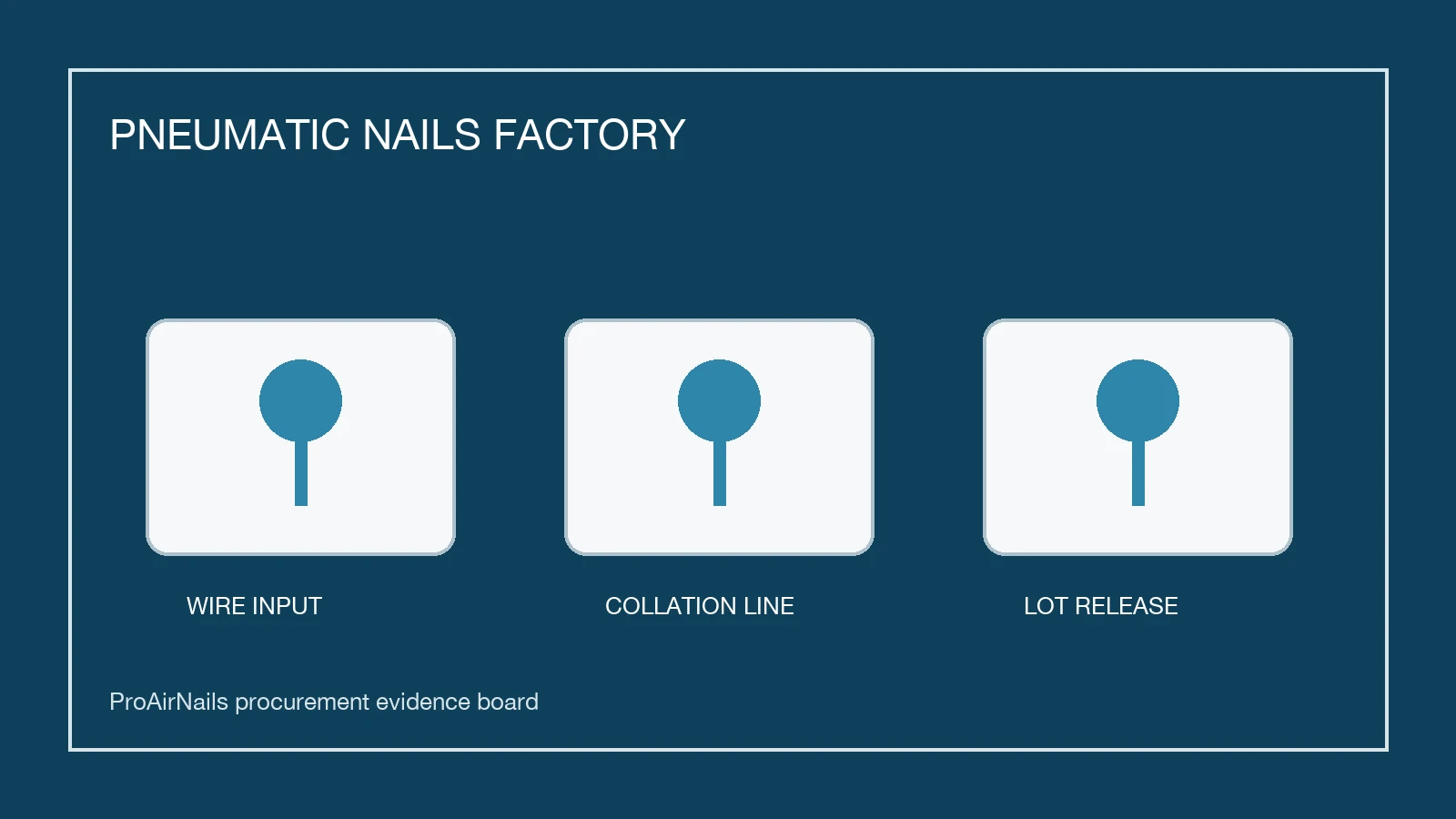
A pneumatic nails factory should be able to show how a fastener moves from incoming wire to released carton. A polished showroom is not enough for a buyer who needs repeatable feeding, clean driving, stable counts, and predictable packaging. The useful audit follows the product path and asks what record proves each handoff.
ProAirNails recommends treating a factory visit as a short evidence review. Walk the wire area, collation line, inspection point, packing station, and complaint file in that order. The objective is not to collect impressive photographs. It is to decide whether the supplier can hold the same specification after the sample has been approved.
Start with the material route, not the reception desk
Ask which wire grades, diameters, finishes, and incoming documents are accepted. A factory may run several products through one building, so the buyer needs to know how material identity is protected. Check whether coils carry a lot code, whether the code follows the material to production, and how nonconforming wire is isolated.
Look for a simple receiving record that names the supplier, material description, measured diameter, finish, quantity, and decision. The record does not need to be elaborate. It does need to be retrievable when a later complaint concerns a particular carton.
When comparing a pneumatic nails factory, ask the same receiving questions at every site. A factory that can show the document, the material tag, and the quarantine location gives the buyer a stronger basis for approval than a factory that only describes its equipment.
Follow the three control points that affect feeding
| Control point | Evidence to request | Buyer question |
|---|---|---|
| Wire preparation | Coil identity, diameter checks, surface notes | Can the lot be traced after it enters the line? |
| Collation | Strip or coil alignment checks, adhesive or weld settings | What prevents loose or proud fasteners? |
| Final release | Sample measurements, count check, carton approval | Who can stop a shipment? |
During the line walk, watch for how operators handle short stoppages. A stable process is not one that never pauses. It is one where a pause has a defined response and does not lead to mixed lots, unrecorded adjustments, or a carton that is released on memory alone.
- Confirm the material code before setup.
- Record any adjustment made during the run.
- Separate held product from released product.
Compare the drawing with the machine setting
Request the working specification for the product selected for the audit. It should identify length, diameter or gauge, point form, head or crown details, collation angle, strip or coil format, coating, quantity, and package labels. Then compare the specification with what is mounted on the machine.
This step catches a common gap: a factory can describe the product correctly in a quotation while the production board uses a shortened code. If the shorthand is ambiguous, the wrong driver, angle, or length can reach the packing line. A buyer should ask how the operator verifies the code before loading material.
What a pneumatic nails factory must prove
The phrase pneumatic nails factory should mean more than a building with nail-making equipment. It should point to a controlled route from material receipt to lot release, with a named person responsible for each decision. This is the minimum evidence ProAirNails recommends recording in the supplier file.
Use a small sample plan that mirrors real work
Take samples from the first accepted setup, the middle of the run, and the last packed cartons. Drive them in the substrate and with the nailer used by the customer. Record feed interruptions, bent fasteners, seating depth, surface marks, and any change in strip behavior. A laboratory-only check may miss the interaction between tool nose, magazine, air pressure, and material.
| Sample stage | Record | Why it matters |
|---|---|---|
| Start of run | Setup code, first measurements, first drive result | Shows whether the line was released deliberately |
| Middle of run | Repeat measurements and feeding observations | Tests process stability, not just setup quality |
| End of run | Carton identity, final count, visible damage | Links shipped goods to the approved lot |
Ask how exceptions become corrective action
Every factory has out-of-specification material at some point. The useful question is what happens next. Ask to see an example of a nonconformance report with the defect, lot, containment step, cause review, correction, and release decision. If the supplier cannot share a customer record, a redacted internal example still shows whether the process is real.
ISO 9001 describes a quality-management framework for controlled processes and improvement; the ISO 9001 overview is a useful reference when defining the evidence a buyer expects. The ISO 2859-1 reference can also help teams discuss lot sampling. For fasteners, the framework still needs application evidence: the buyer must connect factory records to tool fit and finished work.
Keep the approval decision narrow
Do not approve every product because one sample performed well. Approve the declared series, tool family, substrate range, finish, packing format, and change-notification rule that were actually tested. If the buyer needs multiple lengths or coatings, assign separate sample codes and release decisions.
ProAirNails supports buyers comparing pneumatic nails, reviewing brad nails, checking staples, and confirming the company background at About ProAirNails. A clear audit pack makes the conversation more useful than a generic factory tour.
FAQ
What should I inspect first in a pneumatic nails factory?
Start with incoming material identification and traceability, then follow the product through collation, inspection, packing, and release.
Is a factory certificate enough to approve a supplier?
No. A certificate can support the review, but the buyer still needs product samples, process evidence, and application checks.
How many samples should a factory audit include?
Use samples from the start, middle, and end of a run when possible so the review tests repeatability.
What records should match the carton?
At minimum, the product code, lot identity, quantity, dimensions, finish, and release decision should connect to the carton label.
Why check operator shorthand?
Short codes can hide a changed length, angle, coating, or collation format if they are not tied to a controlled specification.
Should buyers test the customer nailer?
Yes. Feeding and seating depend on the actual tool, magazine, pressure, driver condition, and substrate.
What is a useful corrective-action example?
A record that names the defect, affected lot, containment, cause, correction, and verification is more useful than a general promise to improve.
Can one approved sample cover all nail lengths?
Only if the buyer has evidence that the full series shares the relevant geometry, collation, finish, and tool behavior.
How should a factory handle process changes?
Changes to wire, coating, geometry, tooling, adhesive, packaging, or inspection rules should trigger review and, where needed, a new sample approval.
What does ProAirNails provide to a B2B buyer?
ProAirNails can organize product specifications, samples, packaging details, and application questions so the buyer can make a defined release decision.