
A pneumatic staple storage life review should judge a known storage history and current usable condition, not assign a universal expiration date from the calendar alone. Two cartons of the same age can behave differently when one remained sealed on a dry rack and the other was opened beside a humid production line.
ProAirNails recommends dividing stock by exposure state, preserving lot identity, and comparing retained or fresh reference samples with stored strips. The conclusion should state what was observed, under which storage route, and what remains unknown.
Replace age with an exposure history
Record manufacture or receipt date where available, but also document warehouse temperature and humidity, condensation events, proximity to doors or floors, pallet wrapping, carton damage, opening date, partial-use handling, and moves between environments. Time is meaningful only when paired with what the product experienced.
Divide stock by packaging state
| State | Evidence to collect | Release concern |
|---|---|---|
| Sealed and intact | Label, lot, carton condition, storage log | Hidden exposure or aged collation |
| Opened and protected | Opening date, reseal, remaining quantity | Moisture and handling entry |
| Opened at point of use | Line environment, dust, tool residue | Feed and contamination |
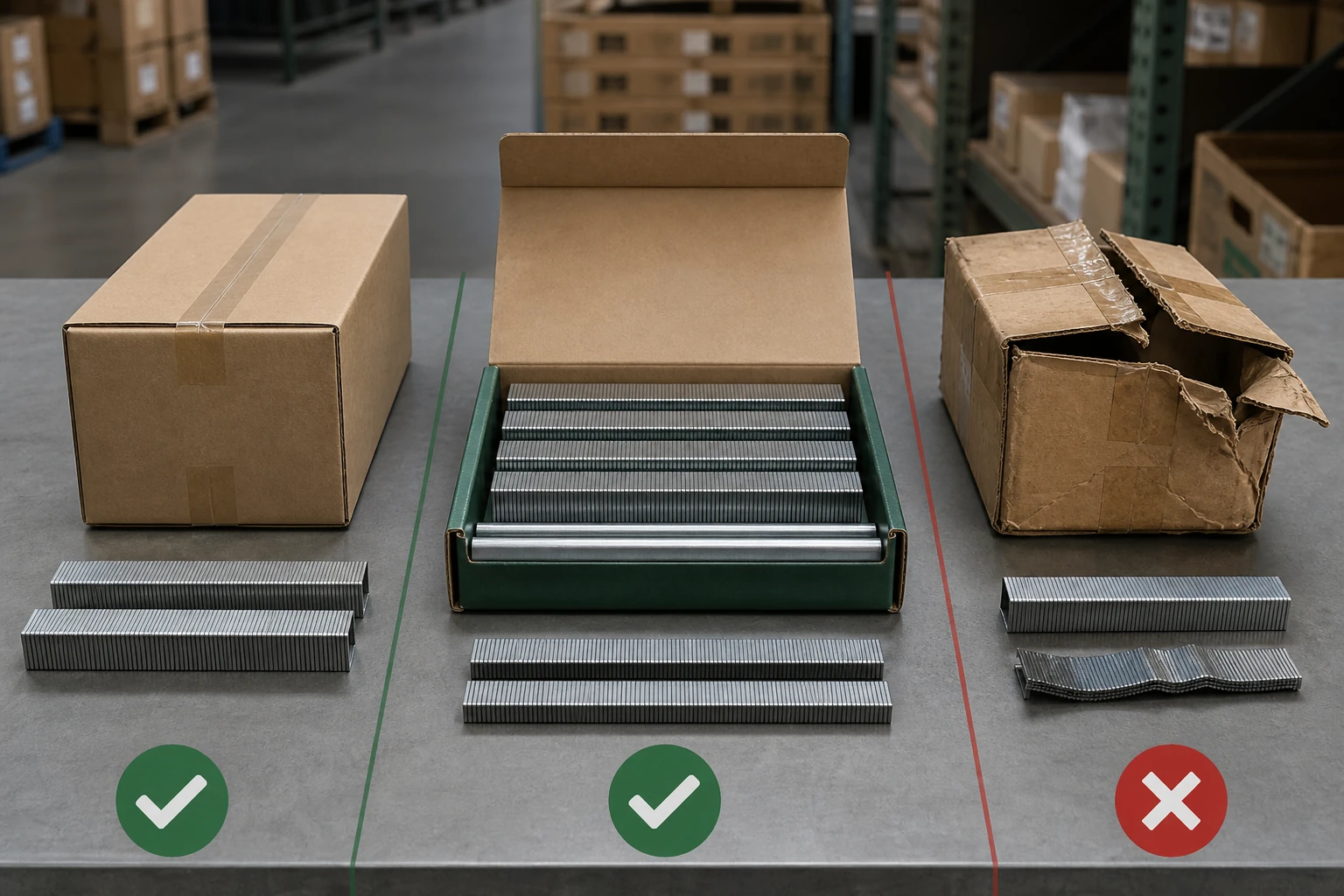
| Crushed or wet carton | Damage map and adjacent stock | Corrosion, mixed strips, deformation |
| Unknown history | Available identity and physical condition | Unbounded risk requiring quarantine |
Create a storage timeline
Map receipt, first opening, warehouse moves, seasonal changes, incidents, sampling, and current review. Do not reconstruct missing dates as facts. Mark them unknown. If data loggers were used, retain their location and calibration status. A sensor above a climate-controlled office does not describe a carton on a concrete floor near a loading door.
Inspect before conditioning
Photograph cartons, labels, inner packaging, strip ends, exposed metal, collation, loose pieces, dust, discoloration, and odor before moving samples into a laboratory environment. Conditioning can stabilize moisture and erase clues about the received state. Keep a portion untouched when further investigation may be needed.
- Separate cartons by lot and exposure state.
- Sample edge, center, upper, and lower positions.
- Keep opened dates on partial cartons.
- Retain a fresh or accepted comparison sample.
- Record every cleaning or sorting action.
Check identity before performance
Confirm series, crown, wire, leg length, finish, strip count, collation, label, and lot. Storage decisions are unreliable if different staple types have been returned to one box. Loose strips without traceable identity should not inherit the carton label automatically.
Examine the functions storage can change
Review corrosion or discoloration, bent crowns and legs, strip straightness, adhesive or carrier condition, separation, tackiness, brittleness, residue, and packaging debris. Then run a controlled magazine and drive check using the intended tool, pressure, substrate, and event count. Record loading effort, skips, doubles, fragments, and interventions.
Use an evidence ladder for disposition
| Finding | Decision band | Next action |
|---|---|---|
| Intact identity and reference-like behavior | Candidate for controlled release | Apply declared lot and monitoring plan |
| Cosmetic change without feed change | Application-dependent review | Check appearance and corrosion requirement |
| Strip separation or residue | Hold affected exposure group | Expand collation and tool-cleanliness checks |
| Corrosion, deformation, or mixed identity | Do not release as normal stock | Quarantine and investigate scope |
| Unknown history with no reference | Insufficient evidence | Obtain controlled samples or dispose by policy |
Understand what accelerated corrosion means
The official ISO 9227:2022 page describes salt spray corrosion tests. Such a test can compare defined specimens and protective systems, but it does not reproduce every warehouse and cannot by itself establish shelf life. Do not convert hours in a cabinet directly into years in storage without a validated correlation.
Sample a defined stock population
The ISO 2859-1:2026 reference describes lot-by-lot attribute sampling using AQL. The buyer still has to define which cartons share an exposure history, what constitutes a defect, the inspection level, acceptance numbers, and response. Combining dry sealed stock with wet damaged cartons into one lot can hide the condition that matters.
Write a storage-aware supplier inquiry
Provide staple dimensions, finish, collation, labels, lot, receipt and opening dates, temperature and humidity records, carton state, photos, tool model, observed failures, sample positions, and intended use. ProAirNails can discuss staples, related pneumatic fasteners, the full product range, and sample options through the inquiry page.
Do not turn a review into a blanket guarantee
A pneumatic staple storage life review cannot prove every hidden carton, future climate, or tool condition. It does not replace stock rotation, dry storage, package protection, tool maintenance, or application approval. ProAirNails can support identified product evidence, while the buyer owns warehousing and final release.
Set a recheck trigger instead of inventing a permanent pass. Reinspect after water ingress, condensation, packaging damage, a warehouse move, an extended open-carton interval, or a feed complaint. Keep the reviewed exposure group physically identified.
For routine control, compare a retained accepted strip with the oldest sealed and oldest opened stock. Repeat the pneumatic staple storage life review using the same observations and tool route. Trend changes by exposure group, not merely by purchase date.
If stock is released with restrictions, state the permitted application, quantity, date, and monitoring requirement. “Use first” is not a technical disposition unless workers can identify the stock and know what to watch.
Use the pneumatic staple storage life review to convert an uncertain carton age into a documented decision about identified, current stock.
FAQ
Do pneumatic staples have one universal shelf life?
No. Product, collation, finish, packaging, storage exposure, and application all affect the decision.
Is the receipt date enough?
No. Record opening, moves, humidity, temperature, condensation, damage, and point-of-use exposure.
Should damaged cartons be sampled with intact ones?
Keep them as separate exposure groups so damage is not hidden inside an average.
What should be checked before a tool trial?
Verify identity, strip condition, corrosion, deformation, collation, and packaging debris.
Can salt spray hours become warehouse years?
Not without a validated correlation for the product and exposure route.
How should open cartons be controlled?
Mark opening date, lot, remaining quantity, reseal status, location, and responsible process.
What is a useful reference sample?
Use a traceable fresh or previously accepted sample with the same specification.
When is quarantine appropriate?
Use it for unknown identity, wet or crushed packaging, corrosion, deformation, mixing, or unexplained feed failures.
Can visual inspection alone release old stock?
Not when collation or tool performance is relevant; connect appearance to a controlled functional check.
What should trigger a repeat review?
Water, condensation, damage, relocation, prolonged opening, seasonal change, or application complaints should trigger review.