
A carton line rarely fails because nobody knows what a staple is. It fails when a quiet setup change crosses a shift boundary. Carton board grade, flap overlap, crown support, leg depth, air pressure, and anvil condition all affect the finished closure. A handover sheet gives the next operator a compact record of what was tested and what still needs attention.
This workflow is designed for teams using pneumatic staples for carton closing on a repeating line. It can be printed, added to a digital batch record, or attached to the carton specification. The sheet should be completed at setup, updated when an exception occurs, and signed at the handover rather than reconstructed later.
Begin with the carton, not the magazine
Record carton board grade, number of plies, flap overlap, seam direction, and the load expected during handling. A staple that performs on a light sample may crush a weaker board or fail to hold a heavy pack. Note whether the carton is empty during the test or filled with the real product, because the internal support can change the clinch.
For pneumatic staples for carton closing, identify the closure pattern: staple count, spacing, distance from the edge, and whether the line uses a fixed head or a hand-guided tool. This pattern becomes the reference for visual inspection. Without it, one operator may add staples to compensate for a poor clinch while another removes them to protect the board.
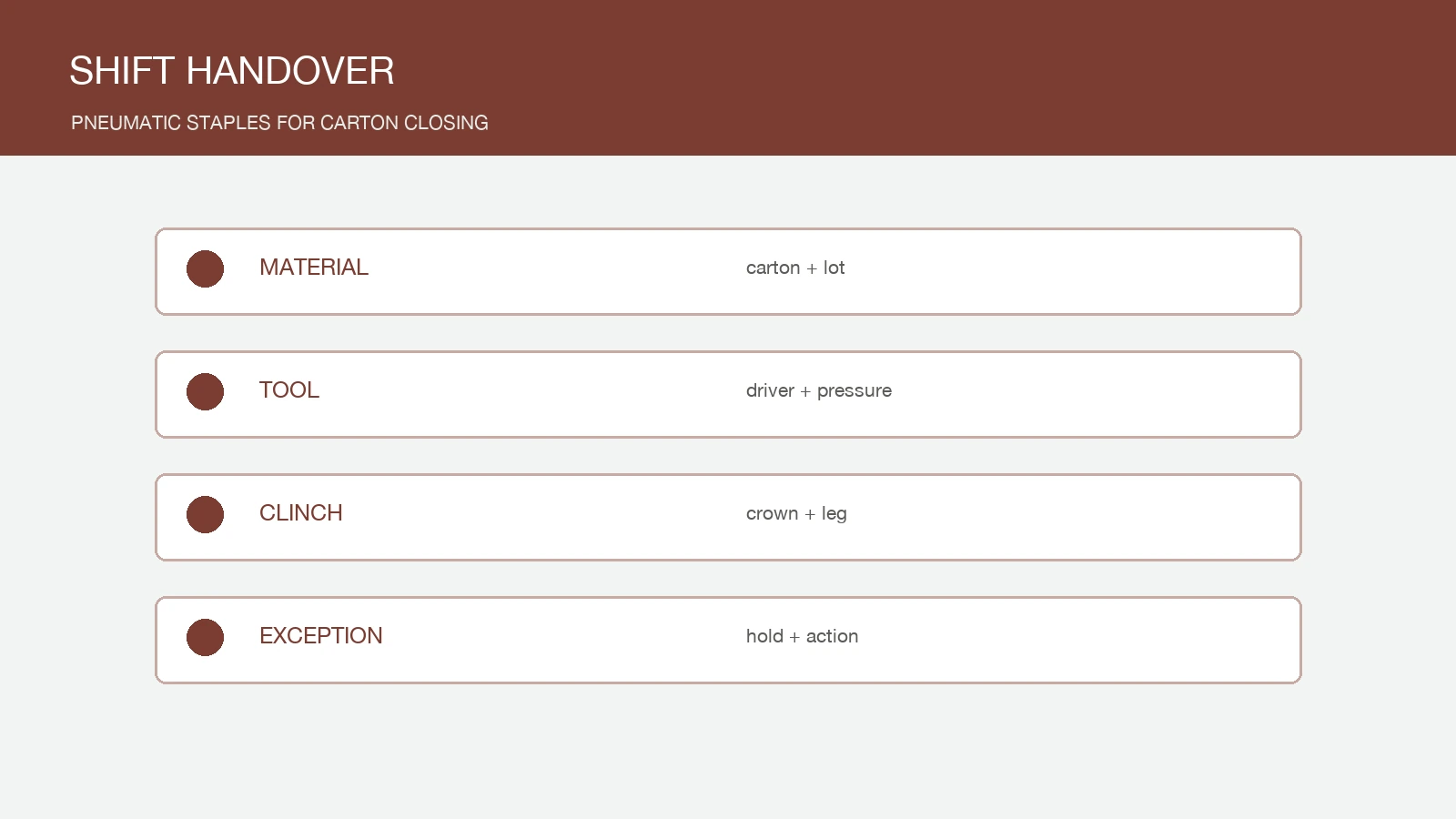
Write the handover in four blocks
| Block | Operator records | Next shift confirms |
|---|---|---|
| Material | Carton code, board condition, staple code and lot | New material matches the release note |
| Tool | Model, driver, magazine, pressure, nose or anvil | Settings are restored before the first carton |
| Closure | Crown support, leg penetration, clinch, spacing | Three marked cartons meet the same pattern |
| Exceptions | Jam, bent leg, open seam, crushed board, temporary change | Held cartons and corrective actions are visible |
The blocks keep a handover factual. “Machine running well” is not a useful note. “P series staple, 10 mm leg, 5.5 bar, three shots at 35 mm spacing, no open seam” can be repeated by another operator and challenged when the carton changes.
Check crown support before leg depth
The crown must bridge the flap without cutting through the board. If the crown is too narrow for the overlap, the paper may tear even when the legs are long enough. If the crown is too wide for the closure head or the seam, feeding and placement can suffer. Test crown width against the actual flap stack.
Leg depth is then judged by the clinch and the board. A leg that stops short can leave an open seam. A leg driven too far can crush the board, tear the liner, or create a snag. The operator should inspect the outside and inside of the carton, not just the top face.
- Mark three consecutive cartons at setup.
- Measure spacing from the reference edge rather than from memory.
- Turn one carton over and inspect the leg return or clinch.
- Hold the batch if a temporary pressure change cannot be explained.
Use a short clinch audit
| Check | Green result | Escalation trigger |
|---|---|---|
| Feed | Strip advances without double feed or empty shot | Jam, loose strip, or inconsistent indexing |
| Crown | Crown bridges the overlap and stays supported | Crown cuts board or misses the seam |
| Leg | Legs penetrate and clinch without tearing through | Legs remain open, proud, or crushed into board |
| Pattern | Count and spacing match the carton record | Operator adds unplanned staples to rescue a seam |
Carton closing staples are a process component, not a decorative item. A small mismatch in crown, leg, or collation can create a line-side problem that looks like an operator issue. Document the observation before changing the tool. That protects the evidence and keeps the correction focused.
Separate a carton issue from a staple issue
When a closure opens, inspect the board, flap overlap, staple, and tool in that order. A warped flap or short overlap can make a good fastener appear weak. A crushed board can hide a correct clinch. A worn driver can create a proud crown that invites a second shot. The handover sheet should say which variable was changed and what result followed.
The ASTM F1667/F1667M driven fastener reference is useful for shared terminology. A supplier-record discussion can use the ISO 9001 requirements page as a quality-system reference. Neither source decides the carton release; the actual board and closure pattern do.
Make pneumatic staples for carton closing visible to quality
Quality should be able to see the last accepted carton, the held sample, the staple code, and the open exception without asking the departing operator to explain it from memory. If a line uses several carton sizes, give each size its own setup block. If a tool is moved between lines, carry the handover with the tool or batch.
A handover for pneumatic staples for carton closing does not replace a carton specification or a finished-load check. It is the shift-to-shift record that keeps those checks repeatable.
ProAirNails helps buyers compare staples, review pneumatic nails, connect carton work with coil nails, and request a sample through Contact Us. A shared handover gives a pneumatic staples for carton closing program a stable starting point each shift.
Close the exception before changing the code
Do not change staple length or crown width to hide a single damaged carton. First isolate the carton lot, check the tool and board, and repeat the marked pattern. If a code change is approved, update the handover, carton specification, purchase record, and operator visual. The next shift should not discover the change by finding a different strip in the magazine.
The goal is simple: the same carton should receive the same closure from one shift to the next, with exceptions visible early enough to correct.
FAQ
What should be written on a carton-closing handover?
Record carton code, board condition, staple code and lot, tool, pressure, crown, leg depth, spacing, accepted sample, and open exceptions.
Why inspect both sides of a carton?
The outside shows crown support while the inside shows leg penetration or clinch. One side alone can hide a weak closure.
Are pneumatic staples for carton closing the same as general staples?
No. Crown, leg, collation, tool fit, and the carton board stack must match the closure task.
What causes an open carton seam?
Possible causes include short leg engagement, poor overlap, wrong crown, low pressure, worn tooling, damaged board, or incorrect spacing.
How many cartons should be checked at setup?
Mark at least three consecutive cartons and inspect the pattern, crown, and inside clinch before releasing the run.
Should the pressure be changed during a shift?
Only with a recorded reason and a repeat check. An unexplained temporary setting should trigger a hold and review.
How can I separate a staple issue from a board issue?
Compare the staple and tool on a known carton, then compare the suspect carton with the approved sample. Change one variable at a time.
What happens when a tool moves to another line?
Carry the tool model, driver condition, magazine, pressure, and approved pattern with it. Recheck the first cartons on the new line.
When should a staple code be changed?
Change it only after the carton, tool, and pattern are reviewed and the new code passes a documented sample check.
Can ProAirNails help with carton closing samples?
ProAirNails can align staple dimensions, tool compatibility, packing, and the closure evidence needed for a repeatable B2B order.