
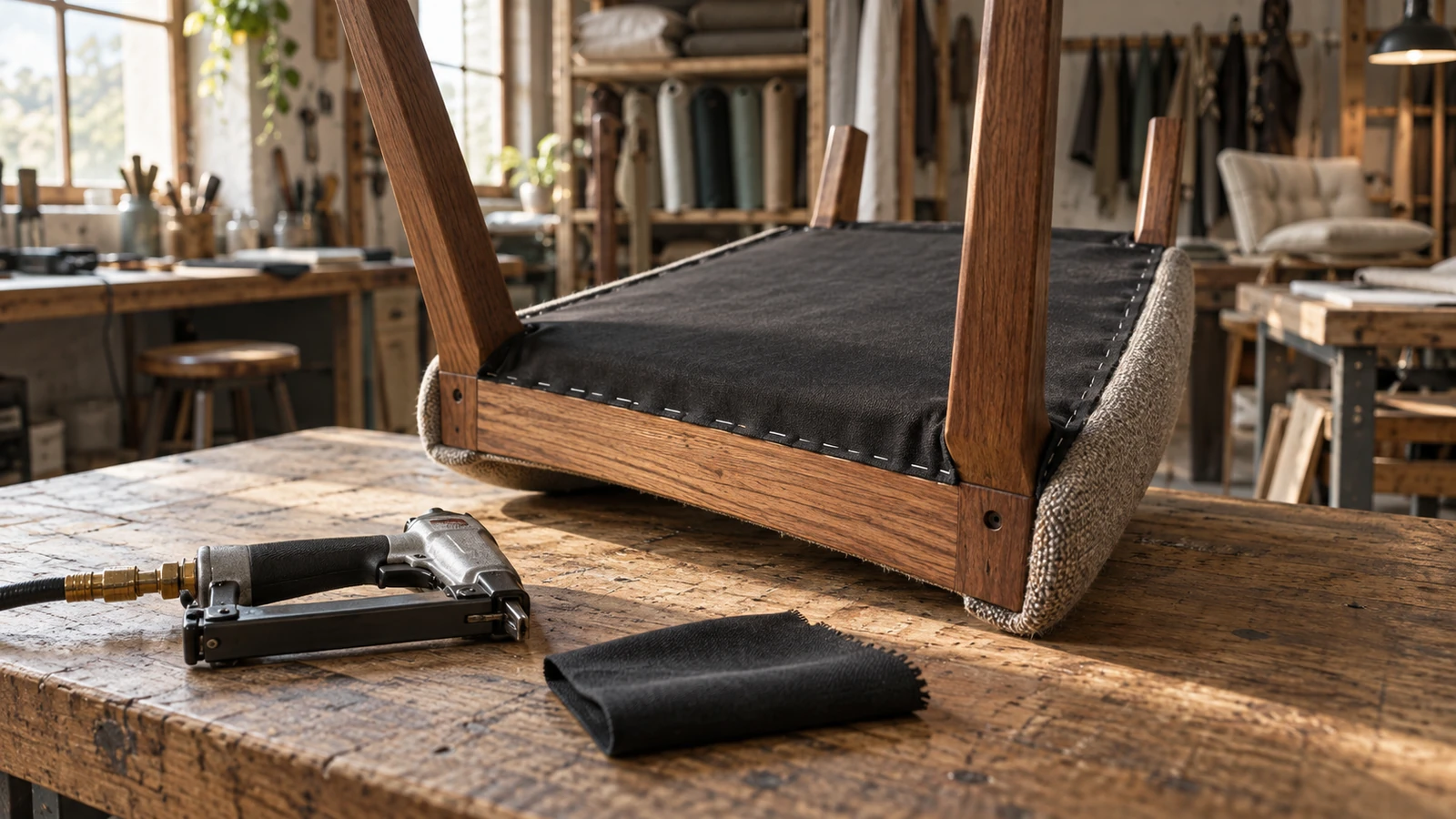
Turn a finished chair over and the underside tells you how the whole piece was built. A dust cover that is pulled tight, evenly fixed and clean at the edges reads as quality before anybody has looked at the frame.
Staples for furniture dust covers do less structural work than almost any other fixing in a factory, and they are inspected more often. It is the fastest operation on the line and the one most likely to be done by whoever has a free hand.
A dust cover is a process record, not a cosmetic sheet
The cover closes the underside of a frame. It keeps dust, crumbs and small objects out of the cavity, stops the webbing and padding from working loose into the room, and gives the interior of the piece a finished boundary.
It also has an inspection role. A warped, puckered cover tells a buyer that the last operation was rushed, whatever happened earlier. That is worth remembering when the same fixing pattern has to be repeated several hundred times a week.
What the cover is expected to stop
The load on a dust cover is small and constant rather than large and occasional. Nothing heavy presses on it, but it hangs under its own weight, breathes with the room and takes occasional contact with a vacuum cleaner or a foot.
That is why cover material is usually a light non-woven fabric rather than a woven one. It needs to hold together, stay flat and accept a staple without tearing away from the crown, and it does not need the strength of upholstery fabric. Match staples for furniture dust covers to that job rather than reaching for the heaviest fixing in the store.
Staples for furniture dust covers: pattern and count
Spacing matters more than quantity. Staples set at even centres hold the cover flat, while a cluster of staples at each corner with nothing in between leaves the middle free to sag and collect everything the cover was supposed to keep out.
Fix the cover in a sequence rather than around the perimeter: pull it, fix the middle of one side, work out towards both corners, then do the opposite side. This is how the material ends up evenly tensioned instead of pulled to one corner, and it is exactly the discipline that makes staples for furniture dust covers look consistent across a run.
| What is being decided | What goes wrong if it is ignored | What to do instead |
|---|---|---|
| Spacing around the frame | Sagging between clusters of staples | Even centres, decided once for the model |
| Sequence of fixing | Cover pulled to one corner | Centre outwards, alternating sides |
| Crown width against fabric | Fabric cuts and starts at the crown line | Crown matched to the material, not the tool |
| Fold at the edge | Raw edge visible from the side | Fold the edge under before the last staples go in |
Pulling the cover without a pucker
Puckering comes from fixing one point hard and then trying to stretch the rest of the cover to meet it. The material has very little give, so it folds instead, and the fold is permanently set by the staple.
The working habit is to keep a light tension with the free hand, fix the centre of a side, then move outwards. Tension with staples for furniture dust covers is controlled by that free hand rather than by the tool. Anything needing more pull than the material gives by hand should be relaxed rather than forced, because a cover pulled beyond its tolerance will pull the folds back out of shape within a week.
Working around legs, rails and hardware
Legs and corner blocks need the cover cut rather than stretched around them. A cover pulled around a leg is under tension from the moment it is fixed and will split along a staple line as soon as the piece is moved.
Cut to the frame line, fold the raw edge under short of the leg, and add a staple either side of the cut so the fabric cannot start. Where hardware sits inside the frame, cut a clearance rather than fixing over it, or the cover becomes part of the mechanism.
Crown type, material and the risk of tearing
A narrow crown concentrates pressure on a small area; wider crowns spread it and hold a light fabric better. With a non-woven cover the crown needs to be wide enough that the material does not start at the fixing when it is pulled, which is the most common reason a set of staples for furniture dust covers is rejected at final inspection.
Leg length is the other half. Long enough to grip the frame material, short enough not to appear on the outside face of a visible rail, and consistent enough that the same pressure seats the crown every time without cutting the fabric in two.
What goes wrong between the frame and the van
| What you see | What caused it | What to change |
|---|---|---|
| Cover puckered from one corner | Fixing sequence, not staple count | Centre outwards, alternating sides |
| Cover sagging in the middle | Wide gaps between staples | Even centres set for the model |
| Split running from a fixing | Crown too narrow for the fabric | Wider crown, or less tension at that point |
| Raw edge visible at the side | Cover cut to the frame instead of folded | Fold before the final staples |
| Cover torn on delivery | Fixing exposed to contact once wrapped | Recess the fixing, and check the packaging |
Checks on the first frame of a run
- Set the tool pressure and the clutch on scrap cover material before starting a batch.
- Mark the staple spacing on the bench for the model, so the pattern does not drift through the shift.
- Check the first finished cover under a raking light, which is how a buyer will see it.
- Confirm the crown and leg against the frame material, not against whatever was loaded in the tool.
- Look at the underside of a wrapped and unwrapped pack, because packaging hides a proud fixing until delivery.
- Keep one sample frame with the cover fitted as the standard for the rest of the run, and label it so ProAirNails and the line are looking at the same reference.
What a staple cannot do here
A staple cannot flatten a cover that was cut too small, and it cannot hold a fold that was forced into the material. ProAirNails does not set the pattern for a customer's model; the pattern belongs to the production drawing, and the fixing simply has to deliver it repeatably.
For how a finished piece is judged under repeated use, the BIFMA furniture standards are the industry reference, and the crown and leg of the staple itself are defined in the ASTM F1667 driven fastener specification. A dust cover is not a structural component, and this article does not treat it as one.
FAQ
How far apart should staples for furniture dust covers be?
Even centres around the frame, close enough that nothing sags between them. Set the figure once per model and put it on the bench.
Which crown suits a non-woven cover?
A crown wide enough not to cut the material when it is pulled. Narrow crowns start tears that appear later in transit.
Should the cover be glued as well?
Not normally. Staples alone hold a light cover, and adhesive makes a future repair or reupholstery harder.
Why does the cover look wrinkled when the frame is upside down?
Because it was fixed from one corner and stretched to fit. Work from the centre of each side outwards instead.
How do I stop the raw edge showing?
Fold the edge under before the final staples, and fix just inside the frame line rather than on the corner.
How do I handle a corner leg?
Cut to the frame line, fold the cut edge under and place a staple either side so the fabric cannot start.
Can a cover be refitted after a repair?
Usually a new cover is fitted. A refitted one keeps the old fixing holes and rarely sits as flat.
What pressure should the tool be set to?
Enough to seat the crown in the frame material with the fabric intact. Prove it on scrap before the run starts.
Does the cover affect the strength of the piece?
No. It closes the underside and gives a finished boundary, but it carries no structural load.
What should a dust cover enquiry include?
Frame material, cover fabric type and weight, staple crown and leg, spacing used and the tool on the line.
What to send with a dust cover enquiry
Send the frame and the fabric, not the staple: rail material and thickness, cover material and weight, the spacing already used on the model and the tool on the line. ProAirNails supplies pneumatic staplers, staple pins and pneumatic nails into upholstery production, and a photograph of the underside of a finished piece shows more than a specification sheet. Start at Contact Us.