
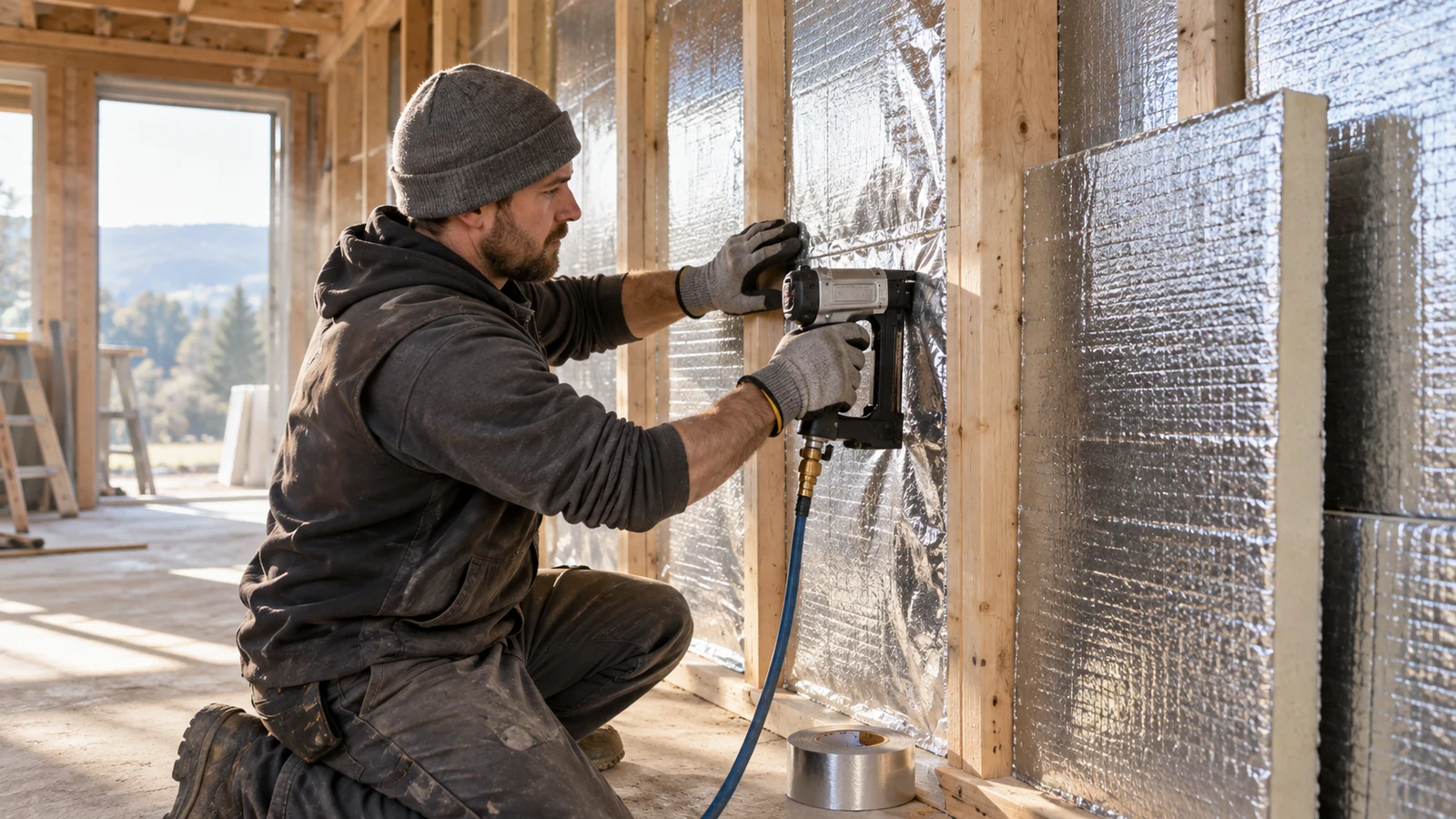
Staples for insulation facing are chosen by the facing, not by the board underneath it. The board holds the insulation in place and carries almost no load. The facing is the layer that has to stay continuous, and it is the layer a careless staple destroys.
ProAirNails supplies collated staples into insulation and dry-lining work, and the failures that come back are consistent: a foil vapour control layer that is perforated along the fixing line, a facing that tears because the crown was too narrow, or a repair that has already been stapled twice before anyone looked at it.
What staples for insulation facing are actually holding
On a faced insulation product the staple has two jobs that are easy to confuse. Mechanically it holds the product against the structure. Functionally it keeps the facing in position long enough for the joints to be sealed and the lining to close.
Those two jobs have different requirements. A staple that is ideal for the mechanical job, driven hard through a thin facing into a soft substrate, can leave the facing creased and the vapour layer compromised. The joint looks finished and the control layer is already failing.
The facing is a control layer, not packaging
Where a facing is specified as a vapour control layer, its continuity is the performance. Every puncture is a path, and a fixing line of staples is a row of punctures. Choosing staples for insulation facing is therefore a decision about the control layer, not about how firmly the product is pinned to the frame. It does not mean staples cannot be used; it means the fixing pattern has to be planned so the punctures can be dealt with.
The ENERGY STAR air sealing and insulation guidance sets out the logic that a control layer only works if it is continuous, and the NAIMA insulation industry resources cover how faced products are expected to be installed and protected. Neither one chooses a staple, and both explain why the facing cannot be treated as packaging.
Crown width and leg length are two decisions
Buyers often ask for a staple by length alone. Crown width controls how much facing the staple holds and how much it tears; leg length controls what the staple reaches behind the facing. Treating them as one number is how a specification ends up holding nothing well.
| Facing condition | Crown consideration | Leg consideration |
|---|---|---|
| Reinforced foil facing | Wider crown spreads the load over the scrim | Long enough to reach the substrate, not through the structure |
| Unreinforced foil | A narrow crown cuts the film instead of holding it | Shorter legs avoid pulling the facing into the board |
| Kraft paper facing | Crown width sets whether the paper tears along the line | Enough leg to hold without crushing the facing |
| Facing over a batten | Width decides how the facing bridges the batten edge | Length set by the batten, not by the insulation thickness |
These are starting points. The combination that works on one facing grade is not transferable to a thinner or unreinforced one.
Edge distance and the tear-out pattern
Facing tears where the load concentrates, and the load concentrates at the ends. A staple placed too close to an edge of the facing, or at the corner of a cut, becomes the start of a run. Moving the fixing line in from the edge is cheaper than repairing a facing that has already run.
Cut edges deserve a second look for a different reason. A facing that is cut short and pulled to reach the fixing has tension in it before the staple is driven, and tension is what turns a small tear into a long one.
Sequence: face, seal, then close
With staples for insulation facing, the order of work decides whether the fixing line can still be sealed. Stapling a facing into place, then discovering that a joint line has to be taped across a row of fixings, is a sequence problem rather than a material problem.
- Set the facing square before the first staple, so it does not have to be pulled into position.
- Fix along the intended line only, and keep the fixing line clear of the joints that will be taped.
- Seal the joints after fixing, and inspect the line for punctures before the cavity closes.
- Leave the off-cut and the facing label with the job so a later repair uses the same product.
Tool setting and the depth of the drive
A pneumatic stapler set for a different material will overdrive a facing. The symptom is a creased line of fixings with the crown sitting in a dimple, and it appears within the first few metres of a run rather than at the end.
Set the tool on a scrap of the actual facing and the actual substrate before starting, and check it again when the facing grade changes. ProAirNails supplies air staplers for this class of work, and the setting that matters is the one that leaves the facing flat rather than the one that seats the crown deepest.
Inspection before the board closes the cavity
Staples for insulation facing can only be inspected while the facing is still visible. Once the lining closes, every defect behind it has to be inferred from a symptom. That makes the pre-close check the most valuable inspection on the job.
| Check | Symptom to look for | Record |
|---|---|---|
| Facing continuity | Tears, runs and punctures along the fixing line | Photographs before the lining closes |
| Fixing pattern | Missing fixings, double-driven crowns | Spacing and the staple used |
| Joint condition | Joints that cannot be taped across | Sealing method and material |
| Facing condition | Facings pulled tight or left slack | The facing product and roll reference |
Repair, not re-staple
When a facing tears, driving more staples into the torn area makes the damage larger and hides it. The repair is a patch: a piece of the same facing, lapped and sealed over the defect, with the fixings kept outside the damaged zone.
A patch that is recorded is a repair. A patch that is not recorded is a defect with a short history, and it will be rediscovered by whoever opens the wall next.
FAQ
Can staples for insulation facing be used on a vapour control layer at all?
Yes, where the fixing pattern is planned and the punctures are dealt with. The requirement is continuity of the layer, not the absence of fixings.
Which crown width should I specify?
Wide enough to hold the facing without cutting it. That depends on whether the facing is reinforced, so it has to be trialled.
Is a longer staple better for thick insulation?
Only if it reaches the substrate. Length beyond that adds breakout risk and can pull the facing into the board.
Why does my facing tear along the fixing line?
Usually a crown that is too narrow, a tool that is overdriven, or a facing that was stretched before it was fixed.
Should the facing be sealed before or after fixing?
Fix first on the planned line, then seal the joints, so the tape is not run across a row of punctures.
How is a torn facing repaired?
With a lapped patch of the same facing, sealed and fixed outside the damaged area, and recorded with the job.
Does the substrate change the staple choice?
It changes the leg length and the tool setting, and it can change whether the facing is held flat or pulled in.
What should be photographed before the lining closes?
The fixing lines, the joints, and any patch, with the facing product visible.
Can a facing be re-stapled to fix a run?
No. Additional fixings in a torn area extend the damage rather than holding it.
What should an enquiry include?
The facing type and reinforcement, the substrate, the fixing pattern you intend to use, and the tool you are running.
Fix the facing schedule, then the staple
ProAirNails supplies staples for insulation facing work alongside staple pins, air staplers and pneumatic nails. Send the facing type, the substrate and the fixing pattern through Contact Us, and the reply can be a fixing schedule that keeps the control layer continuous instead of a staple size chosen by length alone.