
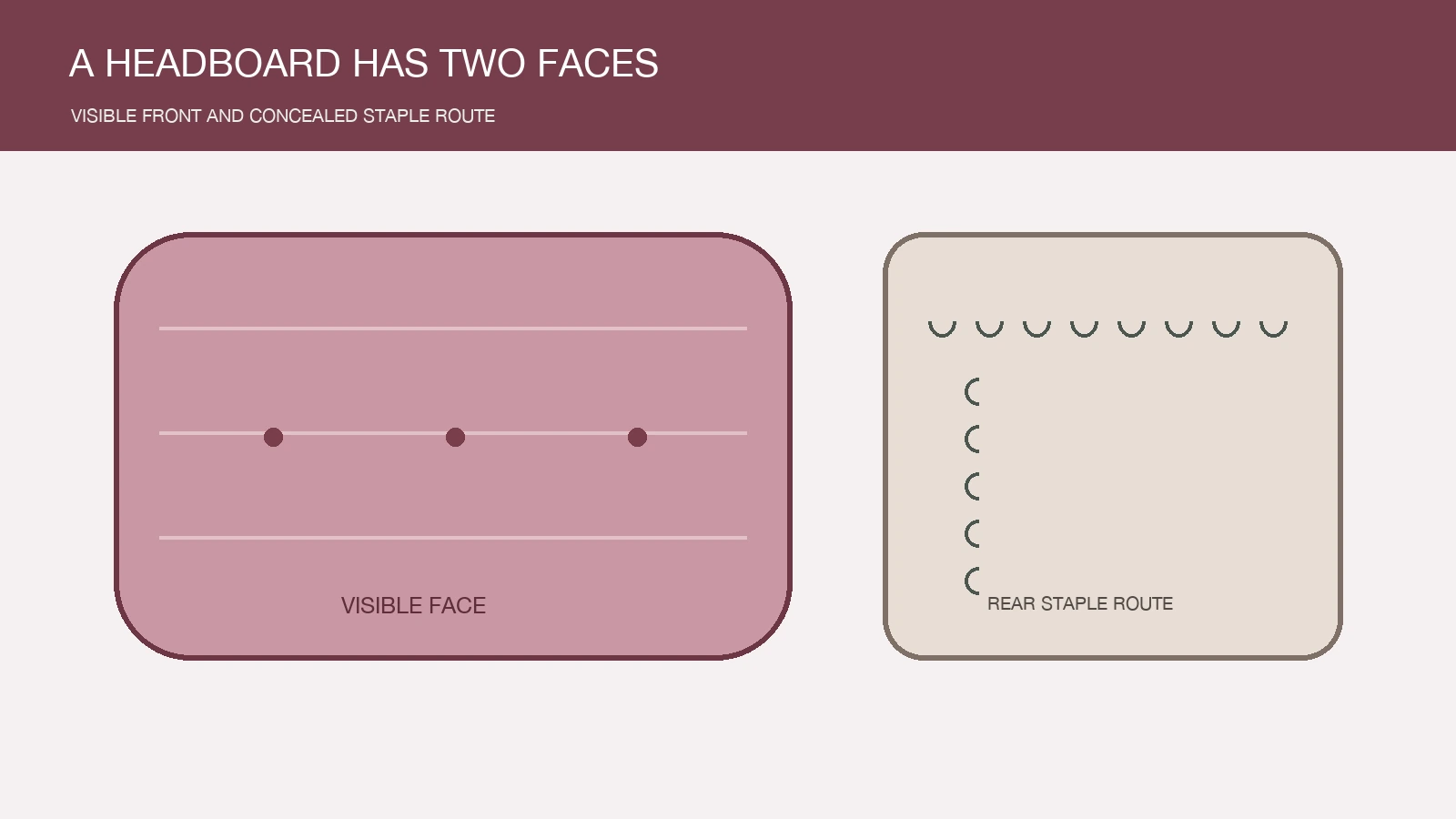
Staples for upholstered headboards should be selected from the finished face backward. The operator drives from the concealed side, but the buyer sees fabric tension, straight edges, soft corners, shadow lines, and any crown that telegraphs through the front. A clean rear edge is useful only when the visible face also remains consistent.
ProAirNails uses a two-face sample: photograph the front before turning the panel over, then mark the exact rear staple route. This keeps appearance, holding, material protection, and production speed in the same approval instead of treating them as separate surprises.
Read the front before studying the staple line
Place the prototype in the lighting and viewing distance expected for the finished room. Look for ripples, hard lines, asymmetry, compressed edges, and differences around buttons, seams, piping, or decorative panels. The visible issue may begin at a hidden corner where fabric thickness doubles.
Mark the zones that tolerate no print-through and the zones that will be covered by backing or mounting hardware. This front map becomes the inspection reference after each trial. It is more useful than judging a loose fabric strip on a bench.
Divide staples for upholstered headboards into working zones
| Zone | Fastening job | Main risk |
|---|---|---|
| Long straight edge | Hold even fabric tension along the frame | Waves, uneven spacing, or crown marks |
| Inside or outside corner | Control multiple folds without a hard lump | Stacked material, cut fibres, or loose fold |
| Foam transition | Secure the cover without compressing the visible profile | Telegraph line or uneven softness |
| Rear backing area | Finish the concealed face and protect handling | Sharp edge, proud crown, or interference |
Give each zone its own pass condition. A staple that performs on a single fabric layer may not seat correctly through a folded corner, and a longer leg may meet unexpected hardware or emerge from a narrow frame.
Build a sequence card for the upholstery team
The card should state material stack, frame or panel type, fabric direction, foam thickness range, fold count, crown width, leg length, wire gauge, finish, tool, pressure, and order of work. Do not prescribe one spacing for every headboard; geometry, material behavior, design, and the manufacturer's process determine it.
- Mark the centreline and reference points before tensioning.
- Secure a small balanced sequence and inspect the front.
- Advance around the perimeter in the approved order.
- Pause before corners and layered folds for a separate setting check.
- Finish the rear cover only after the face passes.
When testing staples for upholstered headboards, keep one unfastened material stack beside the finished sample. It helps a later inspector understand what the crown and legs actually passed through.
Control tension without using the staple as a cure
A staple cannot correct a poorly cut cover, inconsistent foam, a warped frame, or an uncontrolled pull. If the face changes as the operator works, stop and identify whether tension, sequence, material, support, or fastener seating moved. Increasing pressure can hide a proud crown while damaging fabric or burying the crown too deeply.
| Observation | Check first | Do not assume |
|---|---|---|
| Ripple on the face | Pull direction, sequence, cut pattern, frame | More staples will flatten it |
| Crown cuts material | Pressure, crown shape, nose, material stack | A shorter leg fixes crown damage |
| Loose corner fold | Fold build, access, support, placement | A longer leg is automatically safer |
| Proud staple on rear | Tool setting, backing density, driver condition | Hammering is an approved production step |
Inspect after the panel is stood and handled
A headboard that lies flat during assembly can change when lifted, leaned, mounted, wrapped, and unpacked. Repeat the visible-face inspection after the normal handling route. Check corners and rear edges for loose fabric, proud crowns, snags, or contact with mounting hardware.
This is a limitation of the small coupon test. It can compare penetration and material damage, but it cannot show full-panel tension, gravity, packaging pressure, or mounting interference. Release the complete prototype before treating a coupon result as production approval.
Keep product compliance separate from fastener approval
The ASTM F1667/F1667M specification supports a shared description of driven staples, dimensions, materials, and finishes. It does not approve a particular fabric stack, headboard design, or pneumatic setting.
Regulatory scope also depends on the finished product and market. The U.S. CPSC upholstered furniture guidance explains the federal definition, exclusions, testing, and labeling framework. Many upholstered bed components fall outside the seating-furniture definition, but a design with an upholstered seating feature may require a different review. Ask the responsible compliance professional; a staple sample is not a legal determination.
Put tool safety into the production method
Pneumatic staplers can cause serious injury. The NIOSH nail-gun safety guidance emphasizes training, work procedures, protective equipment, and safer trigger controls. Follow the tool manufacturer's instructions and the workplace safety program when testing or producing upholstered components.
Do not defeat a safety contact to reach a tight corner. Change the approved assembly method, tool access, or component sequence. A visually clean corner does not justify an unsafe operation.
Order from the approved material stack
ProAirNails can help buyers review staples, compare related air staple pins, coordinate pneumatic fasteners, and submit a headboard sample brief through Contact Us. Include the frame, full material stack, fold zones, tool, current staple, finish, pack count, order quantity, destination, and timing.
At reorder, check crown, legs, gauge, point, finish, strip geometry, adhesive bond, count, carton label, and lot identity. The final approval for staples for upholstered headboards should link that product record to front-and-rear photographs and the full-panel handling check.
ProAirNails treats the visible face as the release view. When the front, rear route, tool method, and reorder sample agree, the buyer has evidence that can travel from design to the upholstery line.
FAQ
What should be mapped before choosing staples for upholstered headboards?
Map visible areas, long edges, corners, foam transitions, rear cover, mounting hardware, and the material stack in each zone.
Is one staple length enough for every zone?
Not automatically. Fold thickness, frame density, access, hardware, and exit risk can change around the same panel.
Why inspect the front before the rear?
The user sees tension, shadow lines, edge shape, and symmetry on the front; rear neatness alone cannot confirm those outcomes.
Can higher air pressure fix a proud crown?
It may change seating, but it can also cut fabric or overdrive the crown. Check the full tool, material, and fastener setup.
Should a coupon test approve production?
No. Use it to compare options, then approve a full prototype through standing, handling, packing, and mounting checks.
What should a sample card record?
Record material stack, zones, crown and leg dimensions, gauge, finish, tool, pressure, sequence, observations, photos, and decision.
Do upholstered headboards fall under U.S. upholstered furniture rules?
Scope depends on the finished design. Review the current CPSC definition and obtain compliance advice for the target market.
What changes require a new trial?
Review changes to fabric, foam, backing, frame, folds, staple, collation, tool, pressure, sequence, packaging, or mounting hardware.
What belongs in a supplier RFQ?
Send the material stack, zone drawing, tool model, current sample, performance concerns, pack format, quantity, destination, and schedule.
What should be checked at reorder?
Compare dimensions, finish, strip, adhesive bond, carton count, label, lot identity, retained sample, and full-panel approval record.